


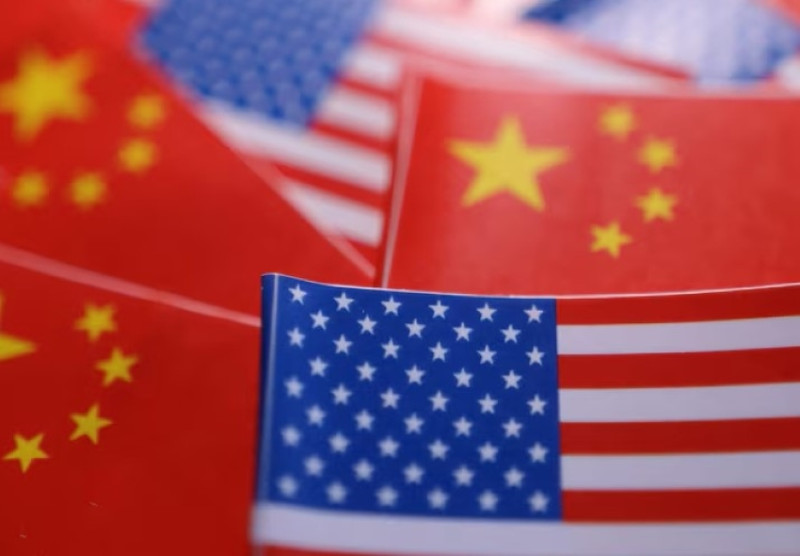
GLOBAL stock markets surged on Monday after the U.S. and China agreed to slash steep tariffs for at least 90 days, tapping the brakes on a trade war between the world's two biggest economies that had fed fears of a global recession.
But the temporary pause did little to address the underlying schisms that led to the dispute, including the U.S. trade deficit with China and U.S. President Donald Trump's demand for more action from Beijing to combat the U.S. fentanyl crisis, Reuters reported today.
While investors cheered the move, businesses were seeking more clarity.
Under the temporary truce, the U.S. will cut extra tariffs it imposed on Chinese imports last month from 145% to 30% for the next three months, the two sides said, while Chinese duties on U.S. imports will fall to 10% from 125%.
In addition to the tariff reductions, China agreed to lift export countermeasures issued after April 2, including restrictions on rare earth minerals and magnets used widely in high tech manufacturing, U.S. trade representative Jamieson Greer said in an interview with Fox News.
Financial markets cheered the reprieve in a conflict that had brought nearly US$600 billion in two-way trade to a standstill, disrupting supply chains and triggering layoffs.
Wall Street stocks finished sharply higher, with the S&P 500 closing at its highest level since March 3 and the tech-heavy Nasdaq Composite recording its highest close since February 28.
The dollar rose, while safe-haven gold prices fell as the news eased - but did not erase - concerns that Trump's trade war could crater the global economy.
Trump and his allies hailed the agreement as proof his aggressive tariff strategy was paying dividends, after the U.S. struck preliminary pacts with Britain and now China.
"They've agreed to open China, fully open China, and I think it's going to be fantastic for China, I think it's going to be fantastic for us, and I think it's going to be great for unification and peace," Trump said at the White House.
It was not yet clear whether the deep trade imbalances that have hollowed out U.S. manufacturing will be addressed.
Even U.S. Treasury Secretary Scott Bessent, who hammered out Monday's agreement with Chinese counterparts in weekend talks in Geneva, has acknowledged it will take years to reset Washington's trade relationship with Beijing.
China's state media said Beijing held firm to its principles while opening a path to more cooperation with the U.S., breaking from its tone of defiance a week earlier.
"Economic and trade cooperation between China and the U.S. has a deep foundation, great potential and broad space," government-run broadcaster CCTV said in a commentary.
Trump campaigned in the 2024 election on addressing unfair trade practices and resurrecting U.S. manufacturing capacity. He won votes from blue-collar workers in states like Michigan and Pennsylvania that have lost manufacturing jobs for decades.
But Trump's tariff policy also drew fire from a range of groups. Small businesses and truckers were girding for major repercussions from the China tariffs, while American consumers worried about rising costs.
Scott Kennedy, a China business and economics expert at the Washington-based Center for Strategic and International Studies, said the administration needed to pull back or risk severe damage to the U.S. economy.
"This is 100% a retreat by the U.S., not a Chinese cave," Kennedy said. "The U.S. was the one that launched the trade war and escalated it. The Chinese retaliated and they've only withdrawn their retaliatory measures."
But Kelly Ann Shaw, an attorney with Akin Gump Strauss Hauer & Feld who worked as a key trade adviser during Trump's 2017-2021 term, said Trump was simply fulfilling his campaign promises.
"The president is doing what he said he would. This is absolutely about resolving disparities in the trading relationship," she said.
She acknowledged that 90 days was not much time to address major U.S. concerns over non-tariff barriers such as subsidies for capital and labour.
"They've got their work cut out for them."
On-And-Off Approach
Seeking to reduce the U.S. trade deficit, Trump targeted countries worldwide with an array of tariffs and especially aggressive levies on China, which he blames for exacerbating the U.S. fentanyl crisis.
Markets shuddered in response, and last month Trump quickly paused most of his "reciprocal" tariffs on dozens of countries, except China.
Trump's on-and-off approach has rattled investors and weakened his approval ratings among U.S. voters worried tariffs will lift prices on everything from toys to cars.
The remaining U.S. tariffs on Chinese imports are still stacked atop prior duties. Even before Trump took office in January, China was saddled with 25% U.S. tariffs he had imposed on many industrial goods during his first term, with lower rates on some consumer goods.
The agreement leaves these duties unchanged, along with tariffs of 100% on electric vehicles and 50% on solar products imposed by former Democratic President Joe Biden.
Retailers may take a wait-and-see approach to 30% tariffs that would drive up prices for shoppers, said Gene Seroka, executive director of the Port of Los Angeles, the nation's busiest and the No. 1 ocean entry point for imports from China.
Monday's accord also does not include the "de minimis" exemptions for low-value e-commerce shipments from China and Hong Kong, which the Trump administration terminated on May 2.
However, the tariffs were cut by more than many analysts had anticipated. Last week, Trump floated a much higher rate of 80%.
Shipping industry representatives said the temporary cuts may prompt many companies to restart loadings of goods while tariffs remain low, but uncertainty around any eventual deal may leave businesses wary of ramping up orders dramatically.
Mike Abt, co-president of family-owned Abt Electronics in Chicago, said the company is working down inventories squirreled away before tariffs went live.
"Everyone wants consistency, and that's been the hard part of this whole thing," he said. "It's so fluid. It's like a game of Risk, you really don't know what the right answer is."
Within the administration, the truce marked a victory for Bessent, a former hedge fund executive who had advocated for the earlier 90-day pause in the global reciprocal tariffs to allow time for negotiation.
"The consensus from both delegations this weekend is neither side wants a decoupling," Bessent said after the talks in Geneva. "We want more balanced trade, and I think that both sides are committed to achieving that."
Bessent told U.S. media that the next meeting had not yet been set but that the sides were ready to continue negotiating. - May 13, 2025















