


Business

China’s December factory activity slows, recovery on track

Nation expected to be only major economy to avoid a recession this year

Updated 5 years ago · Published on

China’s December factory activity slows, recovery on track
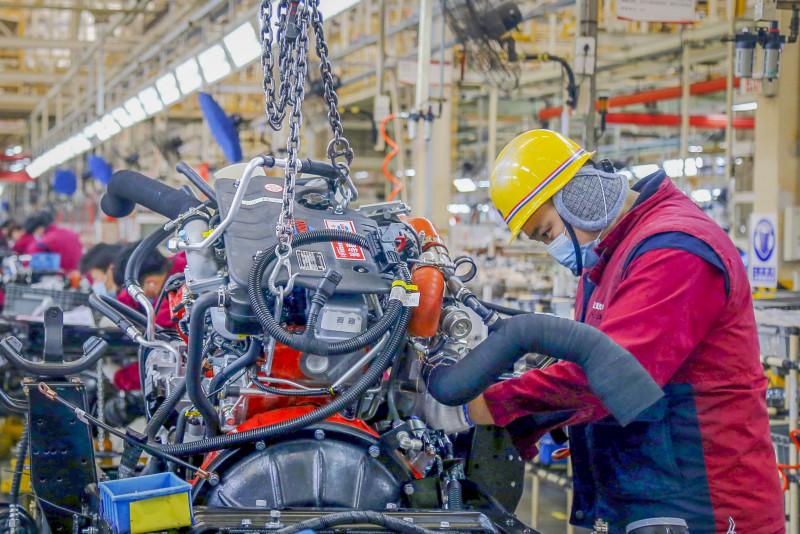
China’s economic recovery remains strong, with the overall manufacturing sector maintaining a steady recovery at a relatively high pace for the year. – AFP pic, December 31, 2020

BEIJING – Factory activity in China slowed slightly in December, data showed today, though it continued to grow as the world’s second-largest economy stays on track to recover from the coronavirus crisis.

While the rest of the world has struggled to overcome the deadly virus, China has bounced back from a rare contraction in the first three months of the year and is expected to be the only major economy to avoid a recession this year.

The closely watched purchasing managers’ index (PMI) – a key gauge of manufacturing activity in China – dipped to 51.9 from 52.1 in November, the National Bureau of Statistics said. It was also slightly lower than the 52 forecast by analysts.

The dip came as demand for Chinese exports was hit by fresh lockdowns and strict containment measures in key markets including Europe and the United States.

Still, NBS statistician Zhao Qinghe said the country’s economic recovery “remained strong”.

“The overall manufacturing sector maintained a steady recovery, with the pace at a relatively high level for the year,” Zhao said.

The manufacturing PMI collapsed to a record low of 35.7 in February after the virus brought much of China to a standstill but economic recovery helped it bounce back to a three-year high in November.

The International Monetary Fund expects the Chinese economy to expand by 1.9% this year.

China’s non-manufacturing PMI – a gauge of sentiment in the services sector – fell to 55.7 in December from 56.4 in November.

China has largely curbed the spread of the virus but a series of local outbreaks in cities including Beijing have reduced the number visiting restaurants, cinemas and other public venues.

These mini-outbreaks have also raised fears of reduced economic activity during the Lunar new year holiday in February. – AFP, December 31, 2020


Related News

Opinion / 1d

The Jensen Huang case: The racial trope driving US - China relations

Opinion / 1w

Honey Trap: Western media response to Jensen Huang and the latest China spy story

Opinion / 3w

Will the AI bubble burst?

Events / 4w

Shanghai trade fair returns to KL with 500 exhibitors in November

Malaysia / 2mth

PM Anwar loses beloved elder brother; Idrus Ibrahim passes away

Malaysia / 2mth

Anwar asks Loke to reconsider resignation over Najib pardon

Spotlight

Malaysia

Anwar receives special recognition as 10,000 Muslims gather in Putrajaya

Malaysia

Video of elderly man being assaulted goes viral on social media

Malaysia

The wide reach of corruption and organised crime in the country

Malaysia

Malaysia pushes to give smaller economies stronger voice in Asia-Pacific trade – Anwar

Malaysia

No tsunami threat to Malaysia after 5.4-magnitude earthquake hits Banda Sea

Malaysia

Who is calling the shots in Negeri Sembilan as Ismail’s position comes under scrutiny?

Opinion

Ayob Khan: When the uniform comes off, the principles remain

Malaysia

MySiren to send emergency alerts to compatible phones nationwide from Nov 29 test

You may be interested

Business

Oil retreat offers limited relief as ringgit weakens against firmer US dollar

Business

NexG share surge puts spotlight on RM7.5b takeover proposal as SC examines trading

Business

Matrix Concepts ranked among top ten developers at TDPA 2026

Business

Pengerang needs to create wider economic value, not just store more oil, says expert

Business

Govt moves to block seven US-blacklisted entities from accessing local data centres

Business

Oil origin claims need official documents, not trader papers, says expert

Business

Three Malaysian firms placed on US trade blacklist over advanced technology diversion fears

Business

Oil extends losing streak for fourth week as supply glut outweighs Middle East tensions


















