


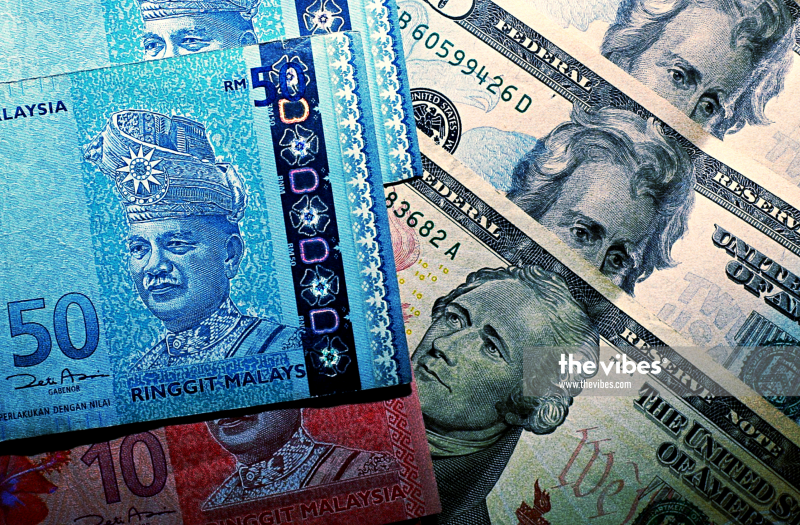
THE ringgit opened marginally stronger against the US dollar on Tuesday, maintaining its footing above the RM3.90 level even as investors adopted a cautious stance amid escalating tensions in the Middle East.
At 8am, the local currency was quoted at 3.9210/9340 against the greenback, slightly firmer than Monday’s close of 3.9225/9295.
Bank Muamalat Malaysia Bhd Chief Economist Dr Mohd Afzanizam Abdul Rashid said oil prices had climbed sharply in response to heightened geopolitical risks, but markets were increasingly turning their attention to how major central banks might react to potential inflationary pressures at a time of subdued global growth.
“The US Dollar Index (DXY) is hovering at 98.381 points, slightly higher than last week’s level of around 97 points.
“Yesterday, the ringgit closed up 0.9 per cent from Friday. So far, it has remained resilient despite concerns over geopolitical tensions in the Middle East, higher crude oil prices and the resulting inflationary pressures,” he told Bernama.
He expects the ringgit to trade above RM3.90 against the US dollar in the near term, likely fluctuating between RM3.90 and RM3.95, in the absence of any signs of de-escalation in the conflict.
In commodity markets, West Texas Intermediate crude slipped 0.24 per cent to US$71.06 per barrel, while Brent crude surged 6.68 per cent to US$77.74 per barrel at the time of writing.
In early trade, the ringgit was mostly firmer against major currencies. It strengthened against the euro to 4.5852/6004 from 4.6031/6113 at Monday’s close and rose versus the Japanese yen to 2.4928/5014 from 2.4984/5032. However, it eased against the British pound to 5.2573/2747 from 5.2460/2553 previously.
Against regional peers, the local note traded mixed. It edged higher against the Singapore dollar to 3.0809/0916 from 3.0854/0912 and was slightly firmer versus the Philippine peso at 6.73/6.76 from 6.74/6.76. It was little changed against the Indonesian rupiah at 232.4/233.3 from 232.5/233.0, but weakened against the Thai baht to 12.5012/5539 from 12.4682/4980.
Market participants are expected to remain vigilant as geopolitical developments and central bank signals continue to shape currency movements in the days ahead. - March 3, 2026















