


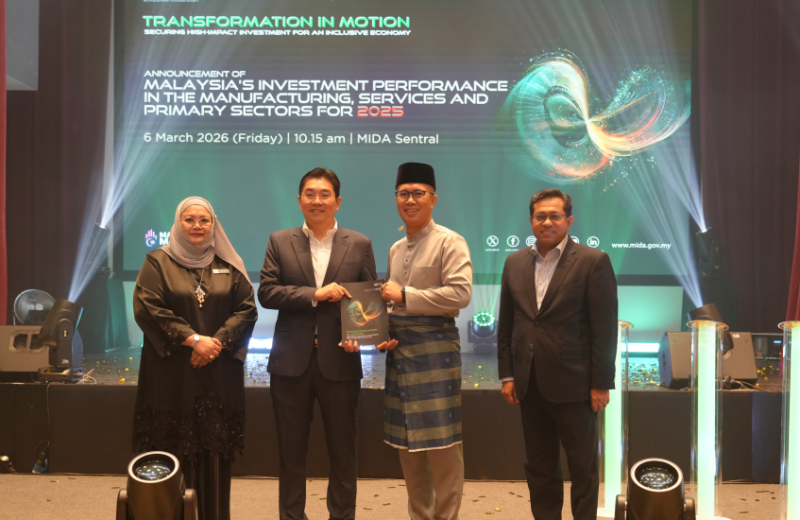
MALAYSIA has celebrated a landmark year for investment in 2025, securing RM426.7 billion in approved projects across the manufacturing, services, and primary sectors, with the potential to generate 244,902 jobs, according to Deputy Minister of Investment, Trade and Industry Sim Tze Tzin.
Delivering the keynote at MIDA Sentral today, Sim emphasised that this record represents an 11 per cent increase over 2024 and demonstrates both domestic business confidence and Malaysia’s continuing appeal to international investors.
“Domestic investments stood strong at RM219.6 billion, representing 51.5 per cent of total approvals.
“When Malaysian companies choose to reinvest and expand at home, it signals belief in our institutions, in our direction, in our future,” he said.
Foreign investment grew by 20.9 per cent to RM207.1 billion, led by Singapore and China, which contributed RM58.3 billion and RM58.0 billion respectively.
The services sector remained the dominant driver of growth, attracting RM281.3 billion in investment across over 7,000 projects and creating more than 130,000 new jobs.
The information and communication sub-sector alone secured RM152.9 billion, driven by investments in artificial intelligence, big data, cloud computing, and data centres, advancing Malaysia’s ambition to become an AI Nation by 2030.
Sim highlighted the Racks Central Group data centre campus in Johor, valued at RM26.6 billion, which will generate over 100 high-skilled positions for Malaysians and support high-density AI computing workloads.
Manufacturing also recorded substantial growth, with RM131.3 billion approved across 1,300 projects, generating nearly 110,000 positions, of which 82.3 per cent are reserved for Malaysians and 46.3 per cent are high-value managerial, technical, and supervisory roles.
Key sectors included electrical and electronics, chemicals, transport equipment, basic metal products, and machinery.
Prominent projects included TF AMD Microelectronics in Penang, producing advanced AI and data centre components and employing over 5,600 Malaysians, and Ain Medicare in Kelantan, a fully Malaysian-owned company producing prefilled syringes and generating 82 high-value local jobs.
The primary sector contributed RM14.2 billion across 32 projects in mining and agriculture, generating over 28 jobs and supporting Malaysia’s broader economic diversification strategy.
Sim underscored Malaysia’s strong project implementation framework, noting that more than 90 per cent of projects approved between 2021 and 2024 have been realised, while 62.2 per cent of 2025 approvals are already in progress.
“The Project Implementation and Facilitation Office monitors high-impact projects in real time, addressing delays in approvals, site preparation, utility supply, and workforce requirements before they become obstacles,” he said.
Looking ahead, Sim reaffirmed Malaysia’s determination to attract high-quality investments amid ongoing global uncertainties.
Key measures include the New Incentive Framework for manufacturing and services, the Industrial Development Act 2026, and the Climate Change Bill, all aimed at promoting sustainable, high-value investment and enhancing local participation.
“RM426.7 billion. 8,390 projects. 244,902 jobs. Trade surpassing RM3 trillion. A currency at its strongest in eight years. An economy growing at its fastest pace in twelve quarters,” Sim said.
“These are the compounding returns of consistent governance, deliberate reform, and the sustained confidence of investors — domestic and foreign alike — who have chosen Malaysia, again and again, as the place to build their future.”
He concluded that Malaysia’s growth strategy is rooted in high-value industries, skilled employment, resilient and sustainable supply chains, and inclusive development reaching every state and community, embodying the government’s vision of “Transformation in Motion.” - March 6, 2026















