


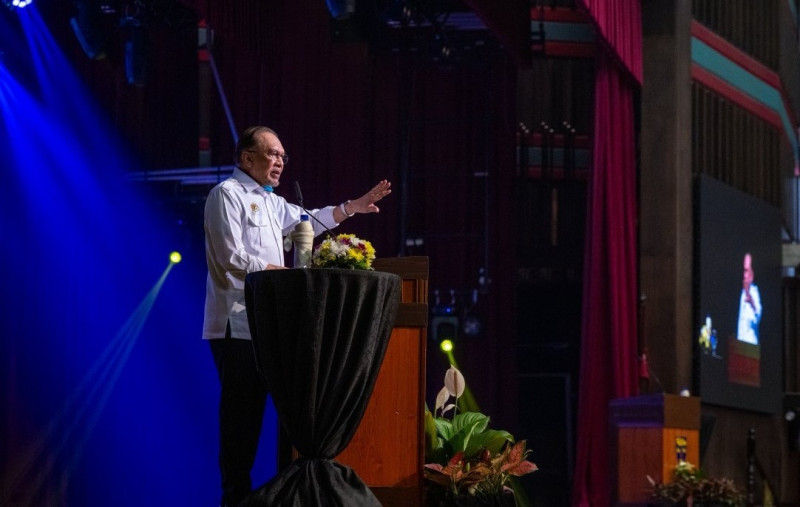
THE country’s ongoing economic reform drive is expected to remain on track only if the current administration led by Prime Minister Datuk Seri Anwar Ibrahim secures a renewed or stronger mandate at the 16th General Election, according to OCBC economists.
Lavanya Venkateswaran, OCBC’s Senior ASEAN Economist, said the present government had demonstrated credibility in implementing gradual but meaningful structural reforms, although the pace of change remained politically vulnerable ahead of the next national polls.
“The momentum could slow or even stall in a worst-case scenario if Pakatan Harapan loses the next general election, but reforms could accelerate if the current administration retains power or secures a stronger mandate,” she said in a research note.
Lavanya noted that recent electoral outcomes involving the ruling coalition had produced mixed results, fuelling speculation over the possibility of another change in government after the next election.
“Recent election history shows that the Prime Minister’s Pakatan Harapan coalition has delivered mixed performances at the ballot box, reigniting discussions about the possibility of a change in government after the next election.
“As such, elections are viewed as a two-way risk to Malaysia’s economic growth and, more importantly, the country’s reform prospects,” she said.
OCBC expects the next general election could be called before February 2028 and potentially as early as this year, particularly if the federal government opts to align it with upcoming state elections in Melaka in December 2026 and Johor in April 2027.
Despite concerns surrounding political continuity, Lavanya said Malaysia’s broader economic trajectory remained relatively resilient.
Preliminary estimates showed the country’s gross domestic product expanded by 5.3 per cent year-on-year in the first quarter of 2026, easing from 6.3 per cent in the final quarter of 2025.
She said export growth continued to benefit from the strength of the electrical and electronics sector, while higher palm oil and liquefied natural gas prices supported commodity exports. Domestic demand, meanwhile, remained firm.
However, she cautioned that fiscal risks were beginning to intensify as global oil prices climbed while the RON95 fuel subsidy remained largely intact for most Malaysians.
“We do not rule out the possibility of further RON95 subsidy rationalisation measures if the Strait of Hormuz remains closed throughout May and June 2026,” she said.
“However, beyond that period, any further adjustments to RON95 retail prices are expected to be implemented more cautiously, taking into account the approaching political cycle and the spillover effects of higher energy prices on headline inflation, which could weaken consumer demand.
“The subsidy rationalisation reforms introduced over the past few years could also result in global prices being transmitted more rapidly into domestic retail prices,” she added.
On monetary policy, Lavanya said Bank Negara Malaysia’s decision to maintain the Overnight Policy Rate at 2.75 per cent had been widely expected, although the tone of the central bank’s latest statement appeared more cautious than before.
According to her, the outlook for both growth and inflation now depends heavily on developments surrounding the conflict in West Asia.
“In our view, Bank Negara Malaysia appears slightly more concerned about economic growth than inflation, indicating a preference to maintain the current policy rate rather than pursue further normalisation in the near term,” she said.
“As such, we maintain our forecast that BNM will keep the OPR unchanged throughout 2026.” - May 11, 2026















