


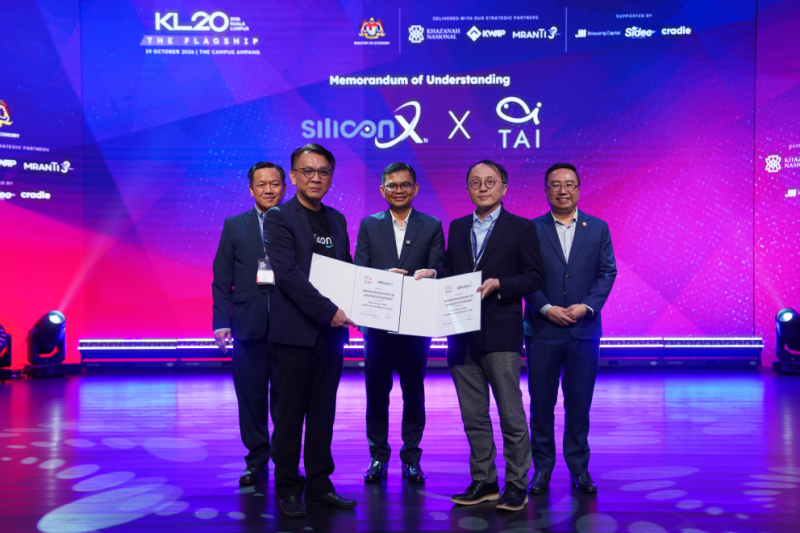
MALAYSIA is pushing local semiconductor companies to turn chip-design capabilities into market-ready products, intellectual property and paying customers, as new industry collaborations under KL20\@Kuala Lumpur 2026 seek to strengthen the country’s position in the global technology supply chain.
Silicon X and Japan’s Tokyo Artisan Intelligence are exploring the joint development, prototyping and commercialisation of reconfigurable artificial intelligence (AI) chips, combining Malaysian chip architecture with advanced AI algorithms.
Separately, five Malaysian companies — Alphaswift Industries, Oppstar Technology, SkyeChip, GreatAsic Technology and Xenith Technology — are gaining access to Arm technology to develop next-generation chips for applications in drones, telecommunications, data centres, smart devices and automotive systems.
Xenith Technology and GreatAsic Technology are also collaborating to strengthen Malaysia’s domestic semiconductor ecosystem.
The initiatives build on the Malaysia Semiconductor IC Design Park’s efforts to move local firms beyond assembly, testing and packaging into higher-value chip design. However, the collaborations and technology access are steps towards commercialisation, not confirmation that the products have reached the market.
Economy Minister Akmal Nasrullah Mohd Nasir said Malaysia needed to shift from technology “made in Malaysia” to technology “made by Malaysia”, with local companies developing proprietary technologies, securing customers and retaining more economic value domestically.
“KL20 is no longer simply about putting Malaysia on the startup map. It is about putting Malaysian innovation into the global market,” he said.
The government’s challenge is to translate startup growth into measurable commercial results. KL20 reports 5,016 registered startups, including 1,609 added since 2024, with total investment of RM51.17 billion and a combined startup valuation of RM202.64 billion.
The Malaysia Semiconductor IC Design Park has 24 global industry partners and has trained 1,525 engineers, while 17 companies are linked to the KL Innovation Belt. These figures indicate the ecosystem’s scale but do not, on their own, establish how many startups are actively operating or how much new investment is being generated annually.
Kuala Lumpur aims to rank among the world’s top 20 startup ecosystems by 2030. To get there, the government is prioritising gaps in follow-on funding, regulatory approvals, testing, procurement and market access, with clear responsibilities and measurable milestones.
Budget 2027 allocates RM450 million through Jelawang Capital and KWAP’s Dana Perintis for startup development, RM1.2 billion through Khazanah and KWAP for local semiconductor companies, RM50 million for UniVC and RM41 million for Cradle Fund initiatives.
A separate RM10 million Intellectual Property Financing Pilot Project, also known as the Innovation Financing Scheme, will be implemented by the Ministry of Economy and the Ministry of Investment, Trade and Industry for 2026–2027. It aims to broaden financing options by allowing intellectual property assets to be used as collateral.
The amounts represent allocations and commitments, rather than funds already disbursed, the ministry said.
It added that financing must be matched by commercial opportunities, including corporate testing facilities, early procurement, technical validation and access to regional supply chains.
The ministry is also studying how social enterprises, non-governmental organisations and community organisations could contribute to innovation alongside existing public and private funding under the 13th Malaysia Plan.
KL20’s 2026 programmes link Penang’s semiconductor and engineering base, Johor’s creative intellectual property and Kuala Lumpur’s capital and market networks into a national startup pipeline.
Ultimately, progress towards the 2030 target will be measured by products reaching the market, Malaysian firms securing repeat customers and stronger participation in international markets, rather than the number of initiatives announced.
“Capital may cross borders in a day. The real achievement is building Malaysian capabilities that stay and grow for decades,” the ministry said. - October 19, 2026















