Business

IMF ups Colombia’s credit line to US$17.2 bil

US$6.5 bil boost aims to help nation cope with economic effects of pandemic

Updated 6 years ago · Published on

IMF ups Colombia’s credit line to US$17.2 bil
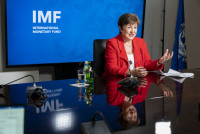
The IMF mission chief for Colombia says the country’s economy is expected to shrink 8.2% this year, worse than the 2.5% drop originally forecast. – Wikipedia pic, September 26, 2020

WASHINGTON – The International Monetary Fund (IMF) yesterday announced that it has raised by US$6.5 billion (RM27.1 billion) a credit line offered to Colombia to about US$17.2 billion, aiming to help the country cope with the economic effects of Covid-19.

“The augmentation was approved in light of Colombia’s continued qualification with very strong institutional policy frameworks, track record of economic performance and policy implementation, and against a backdrop of higher external risks and a larger-than-expected adverse impact from the Covid-19 pandemic,” said the Washington-based crisis lender in a statement.

Colombia has had a flexible credit line (FCL) since May 2009, and the IMF board has renewed it every two years, providing the country with money that can be deployed to head off a crisis.

The latest renewal in May was for US$10.8 billion, but deputy IMF managing director Antoinette Sayeh, in a statement, said Colombia’s downturn is deeper than expected and the nation is set for its worst recession on record.

“The augmentation of access under the current FCL arrangement will help Colombia manage heightened external risks, protect ongoing efforts to effectively respond to the pandemic, continue to integrate migrants from Venezuela, foster inclusive growth and reduce external vulnerabilities.”

IMF mission chief for Colombia Hamid Faruqee said the country’s economy is expected to shrink 8.2% this year, worse than the 2.5% drop originally forecast.

“We do expect growth to rebound,” he said, predicting the gross domestic product increasing 4% next year.

Colombia is one of five countries that have received an FCL, along with Chile, Mexico, Peru and Poland, which exited the arrangement in late 2017.

None of the countries has drawn on the funds, said the IMF. – AFP, September 26, 2020

Related News

Sports & Fitness / 3y

Liverpool supports striker Luis Diaz after parents kidnapped in Colombia

Business / 3y

More weaknesses, vulnerabilities in US banking possible: IMF chief

Business / 3y

IMF warns of ‘more salient’ risks to further trade fragmentation in Asia Pacific

Business / 3y

IMF urges European central banks ‘not to stop’ raising interest rates

Business / 3y

‘Weigh pros, cons of Asian Monetary Fund carefully amid rising geopolitics’

Business / 3y

World economy yet to overcome weak growth, high inflation: IMF chief

Spotlight

Malaysia

Anwar receives special recognition as 10,000 Muslims gather in Putrajaya

Malaysia

Video of elderly man being assaulted goes viral on social media

Malaysia

The wide reach of corruption and organised crime in the country

Malaysia

Malaysia pushes to give smaller economies stronger voice in Asia-Pacific trade – Anwar

Malaysia

No tsunami threat to Malaysia after 5.4-magnitude earthquake hits Banda Sea

Malaysia

Who is calling the shots in Negeri Sembilan as Ismail’s position comes under scrutiny?

Opinion

Ayob Khan: When the uniform comes off, the principles remain

Malaysia

MySiren to send emergency alerts to compatible phones nationwide from Nov 29 test

You may be interested

Business

Matrix Concepts ranked among top ten developers at TDPA 2026

Business

Oil retreat offers limited relief as ringgit weakens against firmer US dollar

Business

NexG share surge puts spotlight on RM7.5b takeover proposal as SC examines trading

Business

Oil extends losing streak for fourth week as supply glut outweighs Middle East tensions

Business

Pengerang needs to create wider economic value, not just store more oil, says expert

Business

Govt moves to block seven US-blacklisted entities from accessing local data centres

Business

Three Malaysian firms placed on US trade blacklist over advanced technology diversion fears

Business

Oil origin claims need official documents, not trader papers, says expert