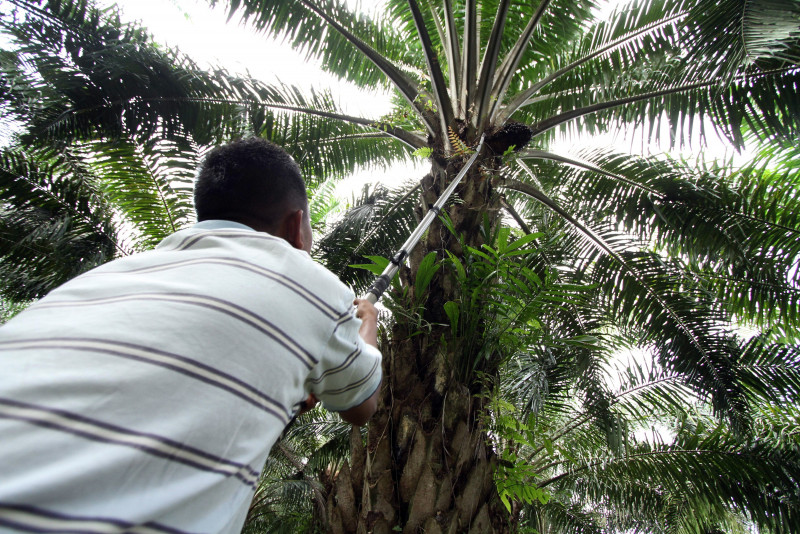
KUALA LUMPUR – Labour shortage is more detrimental to both estates and smallholders in Malaysia’s oil palm industry than a global price drop, according to a Khazanah Research Institute (KRI) study.
The institute said a 30% reduction of labour from the current level would see production fall by half, and a further reduction of 80% would lead to system collapse as production reaches only 20% from the business-as-usual level.
“Therefore, a Covid-19 outbreak among migrant workers in the oil palm estates could prove detrimental.
“As such, industry players must be vigilant in ensuring adherence to Covid-19 standard operating procedures, improving workers’ accommodations, and adopting digitalisation to minimise menial processes,” said Prof Datin Fatimah Mohamed Arshad, the lead author of the study and visiting senior fellow of KRI.
The study, titled The Implications of the Dominant Shift to Industrial Crops in Malaysia: System Dynamic Model of Industrial Crops, aims at identifying key policy interventions towards revitalisation of the agricultural sector using a system dynamics modelling tool.
The specific objectives are to identify structural and institutional factors and policies that drive the agricultural shift, and identify factors that cause low productivity to develop a system dynamics model to capture these relationships and simulate alternative policy interventions.
Meanwhile, the study also revealed that Malaysia’s oil palm planted area is nearing its ceiling limit of 6.5 million hectares, with 5.9 million hectares belonging to large estates while 986,000ha (17%) is owned by smallholders in 2019.
It showed that to reduce the dependence on land, there is a dire need for the oil palm industry to improve yield, expedite replanting, and reduce non-labour input cost to increase production and revenue.
“The replanting rate normally practised by the oil palm sector (in the country) is at 12%, meaning that 12 new trees are typically planted per year for every 100 over-mature trees.
“However, our simulations showed that the optimal replanting fraction to give the best yield per hectare for an estate is 15%, and a smallholder at 17% instead of the usual 12%,” it said.
The study also found that development support for smallholders would yield higher impact to them, particularly on their returns per hectare, compared with estates.
“Investments on the smallholders will create inclusive growth, equitable distribution, and, hence, sustainability of the oil palm sector,” KRI said.
Historically, it said, Malaysia was once a world leader in cocoa and rubber production. Over time, however, there has been a dominant shift to oil palm.
According to Fatimah, the study showed that the shift was driven by higher oil palm profits compared with rubber and cocoa.
The study said that currently, out of eight million hectares of agricultural land, six million hectares (74%) is oil palm planted areas, with declining shares in the rubber and cocoa sectors (14% and 2%, respectively).
Meanwhile, the food industry takes up 10% of agricultural land in the country. – Bernama, January 25, 2021