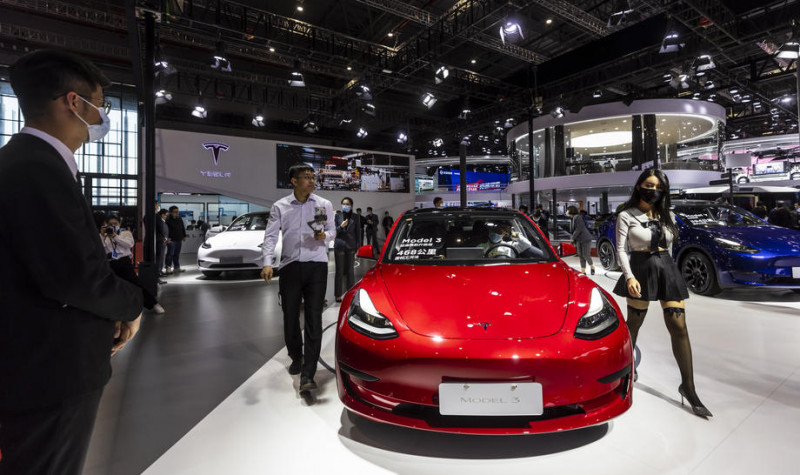
SHANGHAI – Thought Big Tech was taking over your life through smartphones? It may be coming for your car next as Chinese firms lead a stampede into auto manufacturing in their battle for more consumers.
Cars are the next major prize in the battle for digital territory, industry insiders say, and the deep pockets and data muscle of big Chinese tech firms will fuel even faster growth in “smart-electric” vehicles – and possibly hasten the arrival of autonomous cars.
In recent weeks, Chinese smartphone giants Huawei and Xiaomi, e-commerce leader Alibaba, and even DJI, the world’s top drone manufacturer, have thrown their hats into the ring.
“This sort of competition is a good thing and will greatly accelerate innovation,” William Li, founder, chairman and CEO of Chinese electric vehicle (EV) producer NIO, told AFP in an interview just ahead of the Shanghai Auto Show.
The first major auto industry gathering of the year opens to the public Wednesday with the global sector looking to China – the world’s biggest and most rapidly electrifying auto market – to lead the way into a post-pandemic future.
Sales in China contracted 2% to 25.1 million vehicles last year – nearly one-third of the global total – but are rapidly recovering thanks to the expanding popularity of electric cars.
Just a tiny fraction of Chinese sales until recently, EVs accounted for around 9% in March, according to official figures.
China’s government expects new-energy vehicles – which integrate the most advanced driving technology – to comprise 25% of car sales by 2025, and recent announcements appear to bode well.
‘Lightning-fast’
Xiaomi, which has rapidly become one of the world’s biggest smartphone suppliers, plans to invest US$10 billion (RM41 billion) over the next decade in a smart EV subsidiary, and Huawei will invest US$1 billion this year.
Alibaba’s autonomous driving unit AutoX has partnered with Japan’s Honda to ramp up testing on Chinese roads.
And, tech giant Baidu said yesterday its Apollo autonomous navigation system would be installed on one million vehicles over the next three to five years.
The moves will focus fresh attention on Apple’s secretive project to develop a self-driving vehicle.
Cars represent a fresh opportunity for companies like Huawei, now rushing to develop its own tech ecosystem after US sanctions banned it from using Google’s Android.
Huawei has realised its current “market limitations”, said Chen Yusheng, chief technology officer for procurement analysis firm Shanghai Autodatas Co.
“(Huawei) will enter a new track in the future, and with its own advantages, including combining software and hardware, will help promote lightning-fast development of smart cars and autonomous driving,” Chen said.
Even potential competitors seem intrigued.
“This is very reassuring. (Tech companies) see there is an opportunity in this industry, which means that this industry still has a very bright future,” said Antoine Barthes, managing director of the automaking joint venture Dongfeng Nissan.
“And they are probably going to shape the industry.”
Tesla sets pace
Autonomous driving remains largely in the testing phase but China is widely expected to take the lead thanks to government encouragement, modern infrastructure, and a head start in deploying necessary 5G networks.
The Shanghai auto exhibition shows how fast things can change in China, said NIO’s Li.
Just four years ago, it was still dominated by traditional internal combustion engines.
“But today, every booth in the hall has electric vehicles, new-energy vehicles. This is a huge change and the very big driving force has been technological change,” he said.
The latest spark was Tesla.
In Shanghai in 2019, Elon Musk’s company built its third factory and is already selling one-fourth of its output in China.
The highest-selling EV brand globally and in China, Tesla is energising the Chinese market and setting the pace for a host of competitors.
New entrants face many challenges, including a lack of automaking know-how that may force them to partner with established manufacturers, providing the “brains” of cars while the latter build the bodies, rather than following Tesla’s self-contained blueprint.
Another hurdle is a global semiconductor shortage, which has hit the auto sector in particular.
Li said the shortages halted NIO’s production lines for five days in early April. He expects further pressure in the coming months, but views that as a blip.
China’s official targets for EVs are actually too conservative for Li.
“I’m much more optimistic,” he said.
“I think that by 2030, more than 90% of new cars sold in China will be smart EVs.” – AFP, April 20, 2021