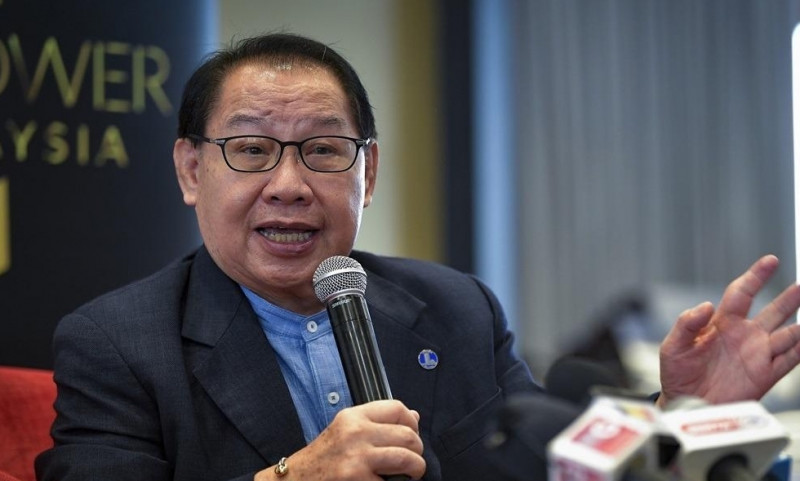

KOTA KINABALU – Sabah expects to use revenue from its carbon trading deal to undertake modernisation and transformation programmes, including in the agriculture sector, said Deputy Chief Minister Datuk Seri Jeffrey Kitingan.
Kitingan said the state expects to raise between RM2.2 billion to RM 5.6 billion a year via the nature conservation deal.
“The funding from nature conservation and carbon trading will unlock conservation assets,” he said.
“We expect to raise RM2.2 billion to RM5.6 billion annually without cutting a single tree and at the same time preserve and safeguard the interest of the indigenous communities,” he said in his speech on the second day of the Sabah International Business and Economic Summit at the Sabah International Convention Centre here today.
According to the United Nations Framework Convention on Climate Change (UNFCCC), “emissions trading”, as set out in Article 17 of the Kyoto Protocol, allows countries that have emission units to spare – emissions permitted but not “used” – to sell this excess capacity to countries that have gone over their targets.
“Thus, a new commodity has been created in the form of emission reductions or removals. Since carbon dioxide is the principal greenhouse gas, people speak simply of trading in carbon. Carbon is now tracked and traded like any other commodity. This is known as the ‘carbon market’,” UNFCCC explains on its website.
Kitingan, who is the state’s agriculture and food industries minister, noted that the agriculture sector’s current contribution to the state is small when viewed in terms of its vast potential.
He said the application of modern farming methods, such as precision agriculture, hydroponics, and the use of machines is only at a rudimentary stage due to the lack of large-scale investors and funding.
Due to the pandemic, Sabah’s agriculture, food, fisheries, livestock and rubber producing activities contributed RM77.5 billion or 10% of Malaysia's gross domestic product in 2020, lower than the RM85.6 billion recorded in 2019.
“If you look at the statistics, the contribution of the agriculture sector to the state’s economy is small compared to its vast potential.
“This is because the majority of players are small individual local farmers who lack the means to transform agriculture into big business, except for the oil palm sector,” said Kitingan.
He stressed that Sabah is in need of big anchor players and investors willing to assist in the modernisation of agriculture in the state.
Kitingan said nature conservation funding would allow Sabah to promote economic activities and accelerate economic growth in poor rural areas.
He anticipated that the funding would also be able to attract up to US$10 billion (RM41.83 billion) in private finance initiatives.
Kitingan said Sabah lacks major players and promotions, and is dogged by the business-as-usual attitude of leaders and civil servants, land issues, power and water supply problems, and shortage of labour especially in the oil palm sector.
However, the state holds potential due to its abundance of land and long coastal areas, with the east coast of Sabah being among the world's thriving tuna breeding areas.
It is also progressing with massive oil palm cultivation, a world-class swiftlet industry, seaweed and cocoa production, and amenable climate and soil fertility.
In view of the Malaysia Agreement 1963 and state rights, Kitingan said Sabah aims to revive the Sabah Padi Board, and establish the Sabah Swiftlet Board and Sabah Oil Palm Industry Authority.
He said Sabah has already been granted authority to issue deep-sea fishing permits on its own marine territories.
“Our ministry has also arranged for state-federal collaboration with federal agencies such as the National Pineapple Industry Board, National Kenaf and Tobacco Board, and the Malaysia Nuclear Agency to develop the respective industries in Sabah,” he said. – The Vibes, January 18, 2022