Business

China’s April exports lowest in two years as virus bites: customs data

Recent lockdowns cause factory shutdowns, transport curbs, congestion at ports

Updated 4 years ago · Published on

China’s April exports lowest in two years as virus bites: customs data
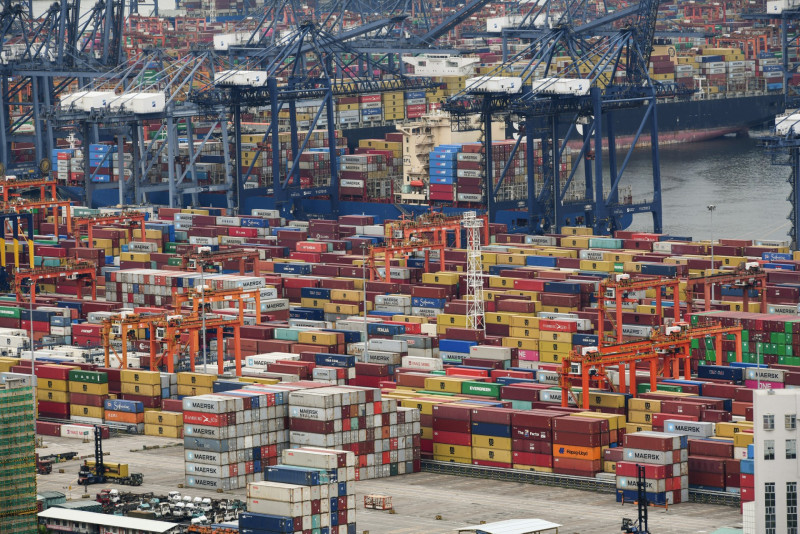
China’s Customs Administration data shows the growing economic damage caused by the country’s recent strict Covid-19 restrictions, with export growth plunging to 3.9% on-year in April. – AFP pic, May 9, 2022

BEIJING – China’s export growth slumped in April to its lowest level in almost two years, customs data showed today, as a Covid-19 resurgence shuttered factories, sparked transport curbs and caused congestion at key ports.

The data shows the extent of growing damage as the world’s second largest economy confines millions to their homes – particularly in key business hub Shanghai – to stamp out its worst Covid-19 resurgence since the early days of the pandemic.

Beijing has persisted with a strict zero-Covid-19 policy involving lockdowns and mass testing, but the economic costs are mounting as manufacturing hubs and supply chains atrophy under gruelling restrictions.

Export growth plunged to 3.9% on-year last month, the Customs Administration said today.

While this was above analysts’ expectations of 2.7% growth according to a Bloomberg poll, it marked the lowest rate since June 2020.

Import growth was flat in April, an improvement from a 0.1% contraction in March, as Chinese consumers remain hesitant under a welter of restrictions across the country.

Customs spokesman Li Kuiwen tried to strike an upbeat note today saying the economy still has room to make a turnaround and that its “positive fundamentals” remain unchanged.

In April, China’s biggest city Shanghai was almost entirely sealed off as it became the epicentre of the country’s worst coronavirus resurgence, with many factories halting production and trucker shortages causing goods to pile up at its port.

Restrictions are also creeping in other cities, including the capital Beijing.

While top leaders have offered words of reassurance for tech, infrastructure and jobs, analysts have warned that the zero-Covid-19 strategy remains a dominant challenge to growth and stability. – AFP, May 9, 2022


Related News

Business / 1d

Pengerang needs to create wider economic value, not just store more oil, says expert

Opinion / 2d

The Jensen Huang case: The racial trope driving US - China relations

Opinion / 1w

Honey Trap: Western media response to Jensen Huang and the latest China spy story

Business / 2w

Energy disruptions - a timely reminder that energy, economic security are interconnected - Minister

Opinion / 3w

Will the AI bubble burst?

Events / 4w

Shanghai trade fair returns to KL with 500 exhibitors in November

Spotlight

Malaysia

Durian trader in Raub loses nearly half a million in AI-based investment

Malaysia

GPS banks on fresh faces, retains Abang Johari and key incumbents for Sarawak polls

Malaysia

Anwar yet to accept Anthony Loke's resignation, says DAP chief remains on leave

Business

MAG to add 10 Boeing Dreamliners in long-term fleet expansion drive

Malaysia

Court imposes gag order in case against AKPS chief Mohd Shuhaily

Malaysia

Cyber scam losses hit estimated RM19.7b in a year

Malaysia

Govt approves RM451m for projects in 66 opposition-held constituencies

By Alfian Z.M. Tahir

You may be interested

Business

Oil retreat offers limited relief as ringgit weakens against firmer US dollar

Business

Pengerang needs to create wider economic value, not just store more oil, says expert

Business

MAG to add 10 Boeing Dreamliners in long-term fleet expansion drive

Business

NexG share surge puts spotlight on RM7.5b takeover proposal as SC examines trading

Business

Matrix Concepts founder honoured as FIABCI Malaysia Property Man of the Year 2026

Business

Three Malaysian firms placed on US trade blacklist over advanced technology diversion fears

Business

South Korean robotic parking company explores opportunities in Malaysia

By Ian McIntyre

Business

Govt moves to block seven US-blacklisted entities from accessing local data centres