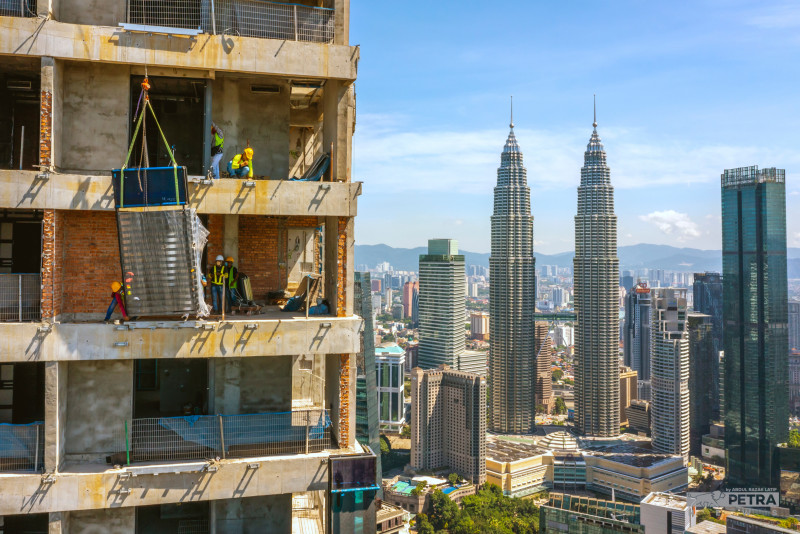
KUALA LUMPUR – A labour shortage as well as rising raw material costs and interest rates amid the weaker ringgit have continued to weigh on the local construction sector despite the economy rebounding post-pandemic.
Construction Industry Development Board (CIDB) Malaysia chief executive Datuk Ahmad Asri Abdul Hamid said the series of overnight policy rate (OPR) hikes by the Malaysian central bank have affected the industry.
“A higher OPR means that the borrowing cost will become more expensive for consumers, including contractors. Banks will revise the costs following the increase in OPR by Bank Negara Malaysia, resulting in higher interest rates for businesses,” he said.
He said the higher cost can limit commercial access to capital.
On November 4, the central bank raised the OPR by 25 basis points to 2.75%, the fourth consecutive hike since May this year.
Labour shortage
Asri said entering the endemic stage has resulted in a significant increase in construction activities as all construction sites can operate without strict standard operating procedures. “(However), the construction industry still has an estimated shortage of about 400,000 workers to date and the CIDB is working closely with industry associations and the Human Resources Ministry to facilitate resolving the issue.”
The National Recovery Council recently called for the shortage of foreign workers to be resolved soon, with arrivals of foreign labour into Malaysia less than the levies already paid at RM713,890 for the approved quota of 467,223.
The council’s chief executive officer Tan Sri Sulaiman Mahbob said on October 31 that the quota approval and levy payment data as of September 12 showed an approved quota of 467,223 workers. However, only 76,000 labour entries from 12 countries were recorded for the same period.
“We found that many workers applied and made payments, but there were fewer people arriving. The question is, why haven’t they come?
“Does it involve their country’s problems or some other reasons? This point needs to be emphasised, otherwise, the agriculture sector, especially palm oil, will continue to suffer,” he said.
He added that labour-intensive industries such as manufacturing, tourism, construction and retail as well as electronics and agriculture have also been affected by the labour shortage.
Currency impact
Asri noted that the ringgit had weakened against the US dollar since March, from below RM4.20 to hitting RM4.72 in October, leading to higher prices of imported goods and materials.
“A weaker domestic currency means that the price for foreign goods will generally rise. Among the construction materials affected are cement and steel.
“The price of mechanical and electrical (M&E) components has also increased because many M&E components are imported from the United States.
“We hope to see the situation improve with the currency strengthening in the future,” he said.
The local currency has been on a downward trajectory against the greenback since early this year, driven by the weakening global economic outlook as well as concern over domestic political stability.
However, of late, the ringgit has started to make gains against the greenback. It rose to RM4.40 versus the US dollar on December 1.
Moving forward, Asri said the performance of the construction sector is expected to be “constant” for the next two years.
“The construction industry is still in the process of recovering from the pandemic.
“Among the main challenges are the increase in the price of some building materials, the lack of workers, the increase in workers’ minimum wage as well as the cost to house them and cash flow issues faced by contractors.
“We hope to see more allocations for infrastructure development and other construction projects to ensure the growth of the construction industry as it will catalyse the growth of many other economic sectors,” he added. – Bernama, December 7, 2022