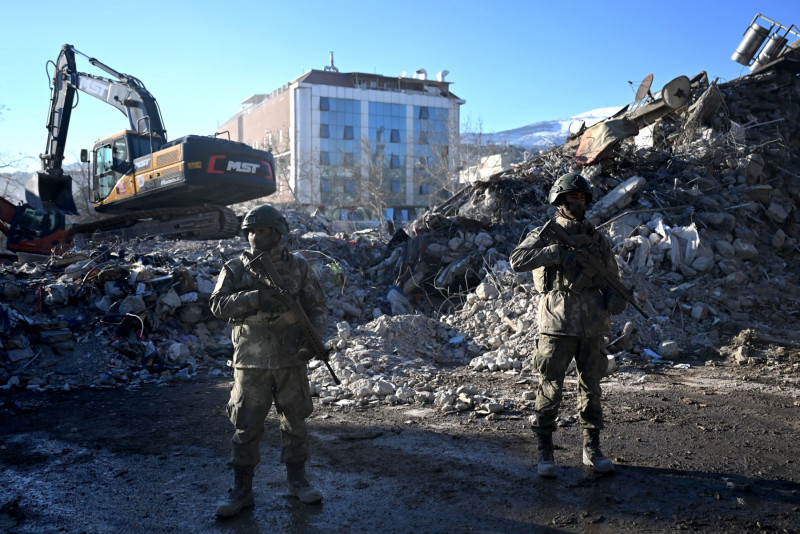
ISTANBUL – Turkiye was already battling runaway inflation and relying on rich allies for funding to keep its economy afloat when a massive earthquake killed tens of thousands, razed entire cities and left millions needing urgent help.
Now, it must pour billions of dollars into rebuilding 11 southeastern provinces flattened by the February 6 tremor – the worst disaster of its post-Ottoman history.
That money will have to come on top of the billions of dollars in election promises that President Recep Tayyip Erdogan has made in the run-up to crucial polls still tentatively planned for May 14.
All this cash could turbo-charge consumer spending and industrial production – two key indicators of economic growth.
The problem for Erdogan, however, is that Turkiye is very short of funds.
The central bank’s vanishing coffers have been replenished by assistance from Russia and oil-rich Gulf states, which has helped Turkiye spend tens of billions of dollars propping up the lira in the past few years.
But economists believe that money is only sufficient to keep Turkiye’s finances in order – and the troubled lira from collapsing – until the May polls.
Now, Erdogan must repair some US$84.1 billion (RM373 billion) in quake damage, according to an estimate from a prominent business group.
Other experts’ estimates are more conservative, putting the total closer to US$10 billion.
Reconstruction boost
With elections in mind, Erdogan has already promised to provide new homes to the millions affected within a year.
Should he find the cash, leaning heavily again on foreign donors, Erdogan will need to allocate much of it to the construction sector to rebuild parts of Turkiye from the ground up.
Although contractors are now being blamed for following lax standards that allowed so many buildings to crumble, Erdogan relied on the sector to modernise much of the country with airports, roads and hospitals.
“The boost to output from reconstruction activities may largely offset the negative impact of the disruption to economic activity,” the European Bank for Reconstruction and Development (EBRD) said.
For the overall economy, at least, there are glimmers of hope.
The area affected is one of Turkiye’s least developed, contributing only 9% to gross domestic product (GDP).
But Turkiye’s agricultural production could take a hit.
Unay Tamgac, associate professor of economics at Ankara’s TOBB ETU University, said the region creates 14.3% of Turkiye’s total agriculture, fishing and forestry output.
The region is a global exporter of food such as apricots, she added, warning there could be a knock-on effect on prices.
The UN’s Food and Agriculture Organisation has warned of disruptions to basic food production in Turkiye and Syria.
Better than 1999?
The quake also damaged energy facilities, infrastructure, transportation, irrigation and logistics, added Tamgac.
Some look back to history for guidance.
Mahmoud Mohieldin, an executive director at the International Monetary Fund (IMF), said the 7.8-magnitude tremor could hurt the economy less than a 7.6-magnitude quake in 1999, which claimed more than 17,000 lives.
An IMF spokesman later said Mohieldin was speaking in a private capacity and not representing the fund’s official view.
The Turkish economy weakened by around 0.5% to 1.0% of gross domestic product in 1999. But that tremor hit the country’s industrial heartland – including economic powerhouse Istanbul.
The economy quickly rebounded, however, growing by 1.5% of GDP in 2000 thanks to reconstruction efforts, the EBRD said.
Last week’s quake also “did not affect areas farther west favoured by foreign tourists, who have become one of Turkiye’s most important sources of foreign exchange”, Wolfango Piccoli, an analyst at Teneo consultancy, said in a note.
Headwinds
The focus, then, is where Erdogan will get the cash to spend on rebuilding.
“It’s clear there will be a need for foreign currency,” said Baki Demirel, associate professor of economy at Yalova University, since Turkiye will now import more.
Turkiye’s sovereign debt levels are relatively low, meaning the government has some leeway to issue long-term debt.
On the downside, foreign investors have shunned Turkiye because of Erdogan’s unorthodox economic views, which include an ill-fated attempt to fight inflation by slashing interest rates.
When the quake hit, Turkiye’s annual inflation rate had slowed from a two-decade high of 85% last year to 58%.
With all the headwinds, economists agree the economy will stall in the coming year.
“Despite the uncertainty and different factors at play, such as global economic conditions and internal political expectations, the Turkish economy is likely to stagnate or grow below its natural rate,” economist Murat Kubilay wrote in a note online. – AFP, February 19, 2023