SANTA CLARA – US regulators pulled the plug on Silicon Valley Bank (SVB) today in a spectacular move that sent global banking shares sputtering, as markets fretted over possible contagion from America’s biggest banking failure since the 2008 financial crisis.
US authorities swooped in and seized the assets of SVB, a key lender to US start-ups since the 1980s, after a run on deposits made it no longer tenable for the medium-sized bank to stay afloat on its own.
Little known to the general public, SVB specialised in financing start-ups and had become the 16th largest US bank by assets: at the end of 2022, it had US$209 billion (RM944 billion) in assets and approximately US$175.4 billion in deposits.
Its demise represents not only the largest bank failure since Washington Mutual in 2008, but also the second largest failure ever for a retail bank in the United States.
In response to the sudden collapse, Treasury Secretary Janet Yellen convened an emergency meeting of top US banking regulators.
“Secretary Yellen expressed full confidence in banking regulators to take appropriate actions in response and noted that the banking system remains resilient and regulators have effective tools to address this type of event,” a Treasury statement said.
Based in the shadow of the world’s biggest tech companies, SVB’s travails have raised fears that more banks may face doom as the fallout from high inflation and hiked interest rates squeezes weaker lenders.
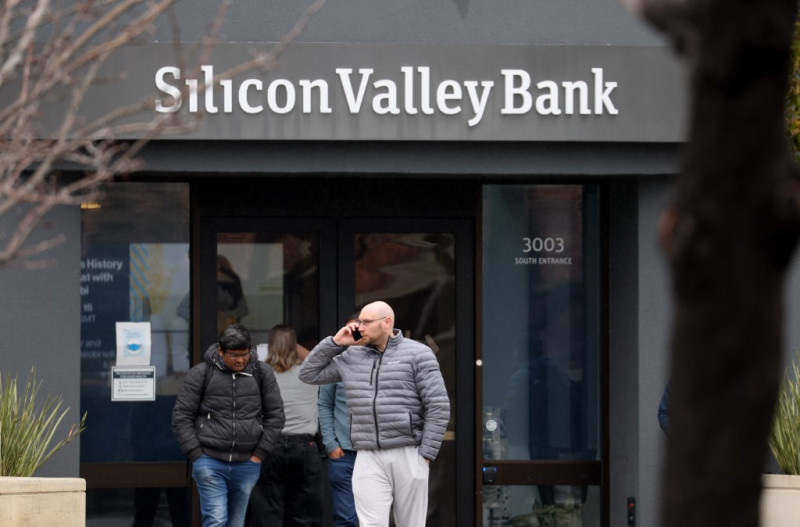
In front of the SVB headquarters on a rainy day in Santa Clara, California, nervous customers spoke in small groups wondering how they could withdraw their money as news spread of the government seizure.
One customer dressed in a T-shirt and sweatpants, and who spoke on condition of anonymity, said he used the bank for payroll at his start-up.
“It’s not a good situation. A lot of really top-tier (venture capital firms) have very high amounts of exposure here,” he said, adding that he was worried for his employees.
Crisis measure
A day after the four biggest US banks lost a whopping US$52 billion in market value following signs of trouble at SVB, European banking giants were similarly mired in the red, with Deutsche Bank down 10% at one stage.
But on Wall Street today, shares in heavyweights Bank of America, Wells Fargo, and Citibank see-sawed, with Yellen telling a congressional panel that she was “monitoring” a few banks.
This was swiftly followed by news that the California Financial Protection and Innovation Department closed SVB and appointed the Washington-based Federal Deposit Insurance Corp to take it over.
The crisis measure protects customers with up to US$250,000 in deposits and crucially buys time to find a potential buyer of whatever remains of the embattled Silicon Valley lender.
CNBC reported today that SVB was in talks with potential buyers after attempts to ride out the crisis on its own failed.
“The debate today is whether SVB issues are SVB’s issues or the start of a bigger issue for the banking sector,” said a note from Patrick O’Hare of Briefing.com.
“There seems to be an allowance in the stock market for it being more of a company-specific problem or at least not a debilitating systemic issue.”
Before the closure, trading in SVB itself was halted today after the bank saw more than 60% of its value wiped out, following the disclosure it had lost US$1.8 billion in securities sales in an effort to raise funds.
Investors fear that other banks could face similar losses as they look to raise cash amid ever rising interest rates with central banks moving aggressively to tame decades-high inflation.
“We’ll have to see how this story develops but something always breaks hard during or after a Fed hiking cycle,” Deutsche Bank analysts said in a note.
“Is this another mini wobble on this front or the start of something bigger? Tough to tell, but I would be stunned if there weren’t many more casualties of this boom-and-bust cycle.” – AFP, March 11, 2023