KUALA LUMPUR – Bank Negara Malaysia (BNM) will continue with its engagements with key stakeholders in navigating Malaysia’s economic transition towards a decarbonised future.
This includes involvement at international platforms such as the Network for Greening the Financial System and capacity-building to better understand and analyse climate risk effects to act pre-emptively.
BNM said it would also continue to prepare the banking sector to be more resilient in the face of climate change and continue to support the transition process within its operational mandate.
“For Malaysia to achieve substantial emissions reductions, embarking on the necessary adaptation and mitigation will be vast in scale and complex in execution,” the central bank acknowledged in its Economic And Monetary Review 2022 report released on Wednesday.
The report warned that consequences from a delay could be far greater, with lasting implications on Malaysia’s growth prospects, potential output, and livelihoods.
If climate change stays on its current course and emissions targets are unmet, the world could lose nearly 10% of its gross domestic product by 2050, it said.
Malaysia’s rising flood risks
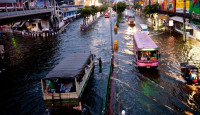
BNM said Malaysia faces rising physical risks from floods and rising sea levels, which calls for urgent adaptation. The country is prone to acute risks stemming from event-driven natural hazards, namely floods, cyclones, and chronic risks driven by longer-term shifts in climate patterns, particularly rising sea levels.
Managing these adverse impacts calls for adaptation measures that are suited to local conditions, including stormwater management, soil erosion prevention, reforestation, and building climate-resilient homes and infrastructure, according to the report.
Key challenges
Among the key challenges are high dependence on coal for power generation, low energy efficiency in the economy, and the significant reliance on fossil fuels for fiscal revenue and external competitiveness.
For instance, Malaysia burns more coal now than it did two decades ago, with 43.6% of electricity generated in 2021 done through coal. Yet, as the most polluting fossil fuel, this dependence is a major hurdle to an enduring low-carbon transition, the report said.
Besides, it noted that the country’s climate policies are fragmented and not sufficiently ambitious.
Climate action in Malaysia started in 2009 and has gathered pace since 2020. However, other countries are carrying out their climate action at a faster and broader pace, the report noted.
This is evident in Malaysia’s low rank (54th) under the climate policy category of the 2023 Climate Change Performance Index, even relative to regional peers.
Role of investment
BNM said the world must invest massively in climate adaptation and mitigation to meet the Paris Agreement targets.
Between 2022 and 2050, over US$270 trillion (US$1=RM4.42) is required to decarbonise the global economy, mostly in the transport, energy, building, and industry sectors.
“For Malaysia, it is estimated that investments worth RM350 billion to RM450 billion will be needed over the next three decades to achieve its emissions targets,” BNM said.
The significant capital expenditure not only supports an orderly transition but also unlocks new opportunities in the green economy, it added.
Malaysia needs to explore existing and new economic opportunities as well as improve the investment climate and funding mechanisms to drive green investments, the central bank advised.
BNM said while the government leads the way in setting the green agenda, its implementation is ultimately the collective responsibility of all stakeholders.
“The pace, breadth, and impact of decarbonisation on the wider economy will consequently determine the degree of monetary policy response,” the central bank said.
According to BNM, an equitable and orderly transition to a green economy will allow Malaysia’s growth and development to be more resilient, sustainable, and inclusive, thereby securing a cleaner and liveable future for the next generation. – Bernama, April 2, 2023