THE proposal to cut education subsidies for wealthy children in Budget 2025 to assist poorer groups appears reasonable as it shows the government’s efforts to ensure targeted subsidies reach those genuinely in need.
However, MCA youth today said the proposal requires thorough guidelines on its implementation to prevent unnecessary conflicts and controversies.
Its secretary-general Saw Yee Fung said the current education system does not categorise schools based on household income.
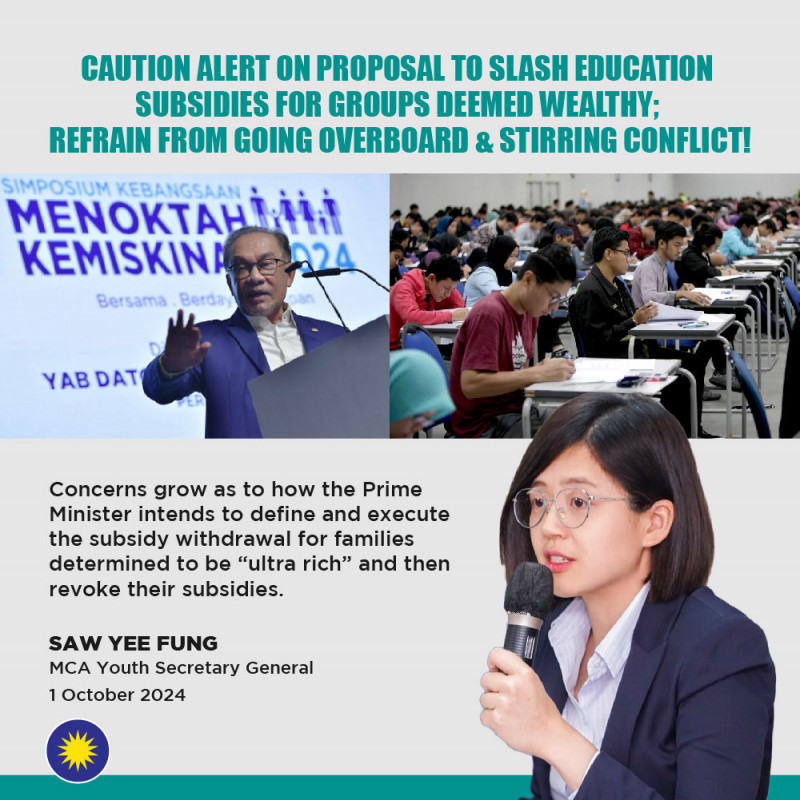
“Concerns grow as to how Prime Minister Datuk Seri Anwar Ibrahim intends to define and execute the subsidy withdrawal for families determined to be “ultra rich.”
“How will the government identify which families are "ultra-rich" to revoke their subsidies?,” she asked.
She said the essence of education should aim to bridge disparities among students.
Since 2018, she said the Ministry of Education has moved away from classifying students based on grades, to prevent children from being labelled from an early age.
“Hence, the premier’s proposal to classify subsidies based on family income is regressive.
“Using income to categorise students creates divisions between the 'wealthy' and the 'poor,' which contradicts the spirit and essence of education,”.
While acknowledging the government's aspiration to assist vulnerable groups, Saw said the lack of details in yesterday’s announcement might foster resentment and 'class envy' sentiments.
She said this could exacerbate social tensions and contravene the principle of education enabling inclusiveness.
“We understand the government's challenges on financial allocation, but we must avoid adopting any anti-wealth sentiments in official discourse or policies.
“Such attitudes can skewer society’s view of wealth as a 'crime,' ultimately undermining social cohesion in the long run.
“The government wields a duty to promote fairness and justice, not to create new conflicts in society,” she added. - October 2, 2024