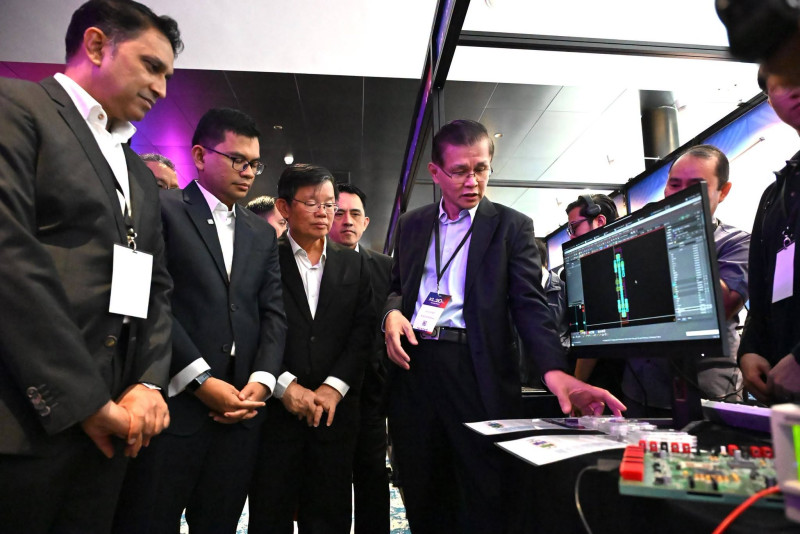
MALAYSIAN companies will get a new platform to develop and commercialise locally made semiconductor equipment with the establishment of a RM25 million National Automation, Testing and Equipment (ATE) Campus in Batu Kawan, Penang.
Economy Minister Akmal Nasrullah Mohd Nasir said the Federal Government allocation under the 13th Malaysia Plan (RMK13) would support talent development, technology qualification, as well as the joint development, testing and adoption of Malaysian-made ATE solutions.
The Penang state government has provided 10 acres of land for the campus.
“The Federal Government’s RM75 million commitment to Penang Silicon Design at 5KM Plus and the National ATE Campus reflects our determination to build a more complete semiconductor ecosystem in Penang.
“This support connects talent development, chip design, engineering, technology qualification and commercialisation, so that more Malaysian companies can develop products, own intellectual property and compete in global markets,” he said.
The RM25 million allocation is in addition to the RM9.25 billion financing framework under RMK13 for implementation of the New Industrial Master Plan 2030.
Penang Chief Minister Chow Kon Yeow said the campus would strengthen the state’s industrial technology capabilities.
“Penang is proud to host KL20@Penang 2026: Silicon Surge with the Economy Ministry.
“We welcome the RM25 million allocation from the Federal Government for the National Automation, Testing and Equipment Campus in Batu Kawan, which will strengthen the state’s industrial technology capabilities.
“Together with the RM50 million Penang Strategic Technology Fund, this cooperation will help strengthen local technology companies and build more local champions,” he said.
The Federal Government will also provide RM12.3 million up to 2030 for the Penang STEM Talent Blueprint, which targets 100,000 students.
The initiatives support Malaysia’s shift from “Made in Malaysia” towards “Made by Malaysia” and align with the National Semiconductor Strategy, which targets at least RM500 billion in investment.
Between 2020 and 2025, Penang recorded RM25 billion in approved manufacturing investments in the machinery and equipment sector, accounting for about 40% of Malaysia’s total investment in the segment.
KL20@Penang 2026 also saw InvestPenang and the Northern Corridor Implementation Authority (NCIA) formalise collaborations with industry, research and talent-development partners to strengthen links between technology, research, talent and local companies and accelerate commercialisation and access to global markets. - September 24, 2026