KUALA LUMPUR – “I want to eat, do colouring activities and learn how to read,” said nine-year-old Asri when asked about why he attended a rehabilitation class in Kg Air Hujung Semporna, Sabah.
Another student at the Semporna Alternatif School, Safirah, 13, said “I sniffed glue due to its candy-like taste. Now, I’m happy to attend this rehabilitation class.”
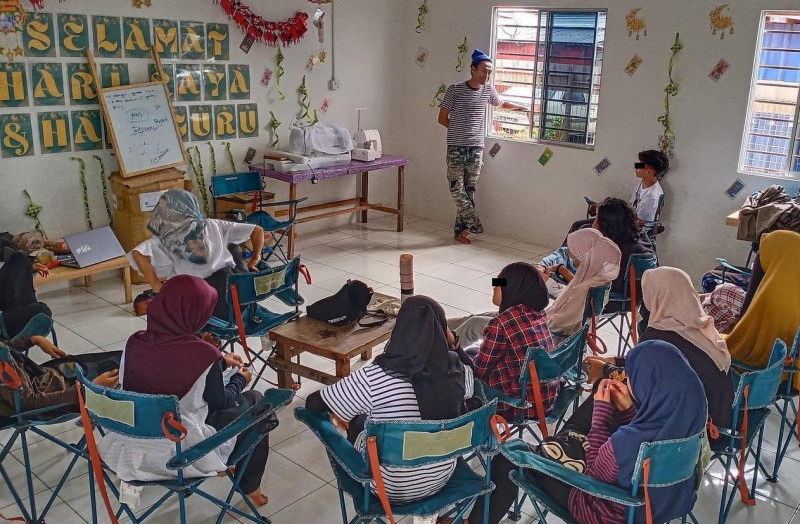
Perhaps the reason why these children were involved in glue sniffing and attended the rehabilitation class might be trivial for some, but for a group of Universiti Malaysia Sabah (UMS) alumni activists who run the school, the willingness of the less-fortunate children to attend the class was an initial success.
The activists’ goal is to gradually rehabilitate these children and help them quit their habit of sniffing glue, equip them with basic knowledge such as reading, counting, and writing as well as expose them to the importance of hygiene through the modules provided.
At the same time, children who do not have the opportunity to pursue formal education like others due to various problems including personal documents and regulations of the authorities will be protected from such an unhealthy habit.
Alternatif School teacher, Mukmin Nantang, 28, said they rented a house in the village and turned it into a rehabilitation class early this year.
Elaborating, he said, among the reasons behind the initiative was to provide the children with a safe space to learn and eventually stop sniffing glue.
“Why do they sniff glue? Because they are hungry and poor, they want to do something to forget their hunger, and secondly because there is no education. So we incorporate these factors into our modules to ensure that these children can eat and learn.
“I can say that 50% of these children have slowly broken the habit. Some are still sniffing glue but our KPI (key performance indicators) is not to get these children to stop doing it immediately,” he told Bernama when contacted.
Another activist, Siti Suhaimah Mustapa, said currently, the rehabilitation class was held every Wednesday, involving students aged six to 13, and would probably be held more frequently in the coming months, depending on the activists’ ability.
“At first, we are the ones who go around finding these children and with their parents or guardians’ consent, we bring them to join our class. Now, they come to the school on their own,” she said.
Meanwhile, Universiti Kebangsaan Malaysia (UKM) Centre for Educational Diversity Studies lecturer Anuar Ahmad said he was impressed and proud of the activists’ efforts in helping children, especially those involved in the abuse of intoxicating substances.
“Addiction to glue‐sniffing has been plaguing us for quite a long time and it involves mostly homeless and stateless children, as well as those who live in squatter settlements,” he said.
He stressed that every child has a right to education and that it was a global responsibility to provide education to all children based on the principles of Education for All (EFA) introduced by the United Nations Educational, Scientific and Cultural Organisation (Unesco).
Therefore, Anuar called on the relevant parties to take the initiative to help and guide the activists on how to manage the school as well as provide them with books and stationery to help ease their burden in helping those children.
“The EFA policy needs to be implemented and we have to send children to school not only for their academic excellence but it is also a mechanism to ensure that their development is monitored and controlled at an early age,” he said.
Meanwhile, Social Protection, Development of Human Resources Rural Areas (DHRRA) Malaysia Maalini Ramalo director said education access for the vulnerable group including stateless individuals should be prioritised.
“Education should be for all and equal opportunity should be given to all children regardless of their background and citizenship status,” she said. – Bernama, June 8, 2022