
Science

A Christmas star: Jupiter and Saturn light the night sky

A rare celestial happening this Yuletide season

Updated 5 years ago · Published on

A Christmas star: Jupiter and Saturn light the night sky
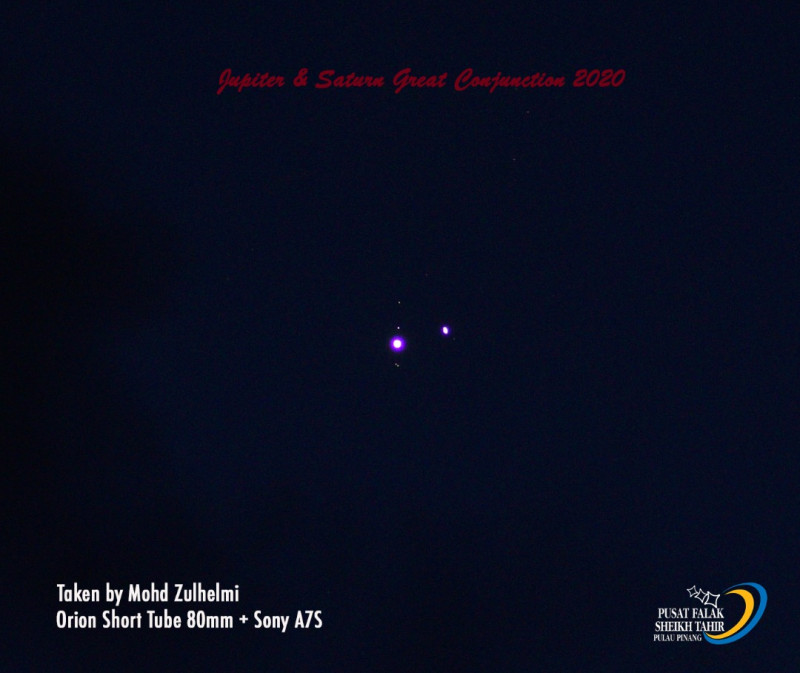
Pic taken by En. Zul Helmi in Pusat Falak Sheikh Tahir. – Whatsapp pic, December 22, 2020

by Haikal Fernandez

EIGHT hundred years in the making – Jupiter and Saturn, the biggest planets in the solar system – aligned last night. 

The last great conjunction to appear as close and as visible as this one happened on March 4, 1226, or when Genghis Khan ruled over a large swath of Asia. 

An astronomical conjunction occurs when any two heavenly bodies appear to pass each other as seen from Earth.

This celestial rarity is regarded as the same astronomical phenomenon which in the nativity story of the Gospel of Matthew, lit the night sky some 2,000 years ago which guided the Three Wise Men to the birth of the baby Jesus, and henceforth became known as the Star of Bethlehem. 

To be a great conjunction, the celestial bodies that need to connect are Jupiter and Saturn. Their orbits align in a way that allows them to seemingly convene roughly every 20 years.

During the 2000 great conjunction, Jupiter and Saturn were near the sun in our sky and were therefore difficult to observe.
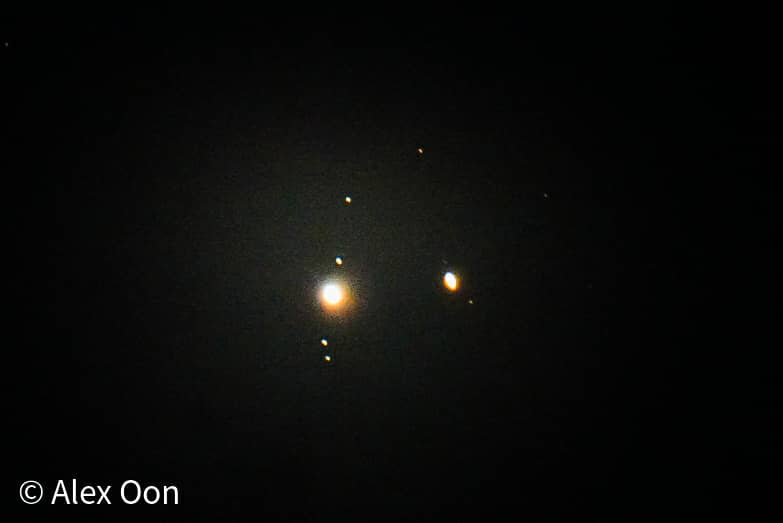
Picture taken by Astronomy Society of Penang member Alex Oon. – Whatsapp pic

Despite the closeness, the planets are not really that close to each other as during their current alignment, they are still separated by a distance of more than 730 million km.

Prof Chong Hon Yew, formerly of USM, and current president of the Astronomical Society of Penang believes that any location on the west coast of the peninsula would be a fine location to look up.

Anywhere with an unobstructed view – including in Kuala Lumpur – of the night sky towards the west and the setting sun would be preferable. 

There is no need for a telescope, as binoculars will suffice for those wishing to catch a glimpse of Jupiter’s four moons and the rings of Saturn.
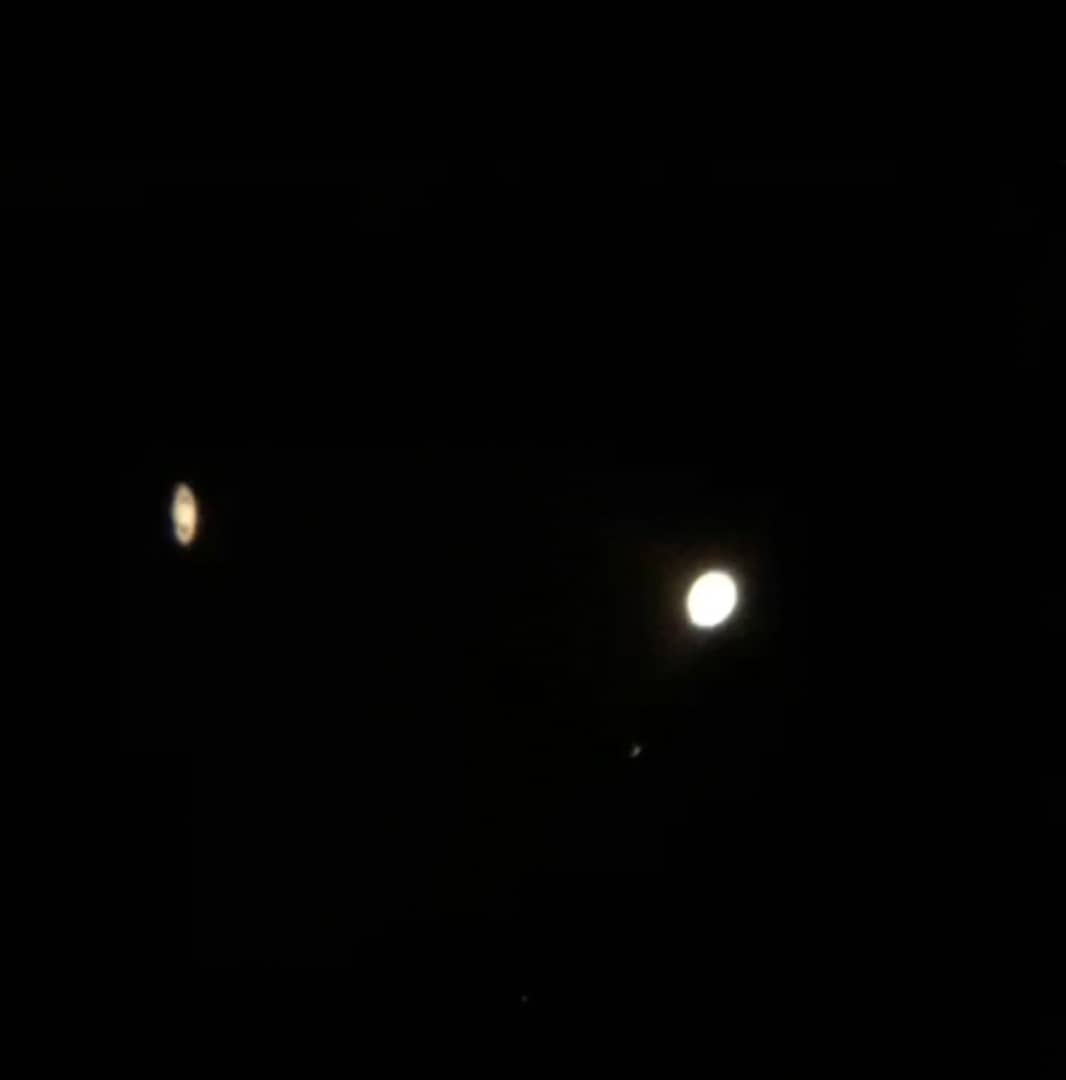
Picture taken by Astronomical Society of Penang member Jacqueline Ong from Butterworth. – Whatsapp pic

For those hoping to see tonight, the viewing information is as given below:

Sunset at 7.11pm.

The altitude values for Jupiter-Saturn are:
7.11pm: 29 degrees above western horizon
7.30pm: 24 degrees
8.00pm: 17 degrees
8.30pm: 10 degrees 
9.00pm: 3 degrees
9.18pm: Jupiter-Saturn set – The Vibes, December 22, 2020
Related News

Stage / 1d

Dancers thrill audience with their enchanting ballet performance

Malaysia / 2d

Penang must appreciate what Anthony Loke has done - Guan Eng

Books / 3d

Book on the life and legacy of Tun Tan Cheng Lock launched

Off beat / 1w

Penang moves to strengthen position as green manufacturing hub

Events / 1w

Annie Tan looks to keep traditional Asian flavours relevant through modern dining

Community / 1w

Penang looks towards AI for greater sustainability

Spotlight

Malaysia

Anwar receives special recognition as 10,000 Muslims gather in Putrajaya

Malaysia

Video of elderly man being assaulted goes viral on social media

Malaysia

The wide reach of corruption and organised crime in the country

Malaysia

Malaysia pushes to give smaller economies stronger voice in Asia-Pacific trade – Anwar

Malaysia

No tsunami threat to Malaysia after 5.4-magnitude earthquake hits Banda Sea

Malaysia

Who is calling the shots in Negeri Sembilan as Ismail’s position comes under scrutiny?

Opinion

Ayob Khan: When the uniform comes off, the principles remain

Malaysia

MySiren to send emergency alerts to compatible phones nationwide from Nov 29 test

You may be interested

Events

Seven companies selected for RM15m corporate innovation programme

By Alfian Z.M. Tahir

Health

Selangor records 18,451 haze-related illnesses, with Petaling clinics hardest hit

Our Planet

Beaver Supermoon lights up November skies, begins four-month celestial spectacle