By Murray Hunter
SOME of the oldest modern Malay urban areas exist in Bangkok.
While the term “kampong” (or kampung) evokes traditional rural villages in Malaysia and Indonesia, Bangkok’s Malay communities represent an earlier, distinct form of Malay urban and semi-urban settlement shaped by forced migration, royal policy, and canal-based livelihoods.
Historical Origins
The oldest Malay villages (or communities) in Bangkok trace their roots to the late 18th and early 19th centuries.
They primarily stem from forced settlements of Malay war captives and deportees from southern Thai-Malay states like Patani, Kedah, Kelantan, and others.
These followed conflicts during the Thonburi (1767–1782) and early Rattanakosin periods.
Siam’s military campaigns subdued rebellious tributary states, leading to mass deportations that resettled thousands, including aristocrats, artisans, and peasants, across central Thailand.
These communities often formed around canals and the city’s periphery, engaging in agriculture, labour (especially canal digging), trade, and construction.
Many remain Muslim enclaves where elements of Malay culture, language (Bangkok Malay or Nahu Bakoi), cuisine, and traditions persist, although assimilation into Thai society has been significant over the generations.
This contrasts sharply with Malay urban development in modern Malaysia
In the Malay Peninsula, Malays were predominantly rural, engaged in agriculture, fishing, and other kampong-based activities.
During the British colonial period, urban areas were dominated by Chinese and Indian communities until the mid-20th century.
Kampong Baru in Kuala Lumpur was only established in 1899 as part of the Malay Agricultural Settlement (MAS) under British rule.
Urban areas like Batu Uban on Penang’s southeast coast were established by Minangkabau settlers from Sumatra around 1734, rather than indigenous Malays. Kampong Tanjung Tokong near Georgetown traces to Sea Gypsy (Orang Laut) settlements.
Sea Gypsy communities stretch along the west coast into Myanmar.
In Kedah, the first modern Malay urban settlement grew around what is now Alor Setar under Sultan Muhammad Jiwa Zainal Adilin II.
Together with Patani, these areas served as springboards for Malay migration and interaction toward Bangkok.
Key Historic Settlements in Bangkok
Ban Suan Phlu (Betel-Vine Garden Village) in the Thonburi area along the Bangkok Yai Canal was founded shortly after Ayutthaya’s fall in 1767 by uprooted Malay households (war captives or refugees).
It dates to the Thonburi era and ranks among the earliest surviving Malay villages. Residents cultivated areca palms and betel vines for the Siamese market.
Bang O (Marsh Grass Village) on the western riverbank upstream from the Thonburi citadel was reputedly founded by Malay survivors of Ayutthaya’s destruction. It features a historic mosque (Bang O Mosque) with distinctive architecture blending Renaissance, Baroque, and Mughal elements, and it remains a visible Malay Muslim community by the Chao Phraya River.
Other Thonburi-area Malay villages — Several lesser-documented settlements along canal sectors survive from the late 1700s. They were often linked to naval or agricultural roles.
Communities in Thung Khru, Phra Pradaeng, Bang Kho Laem, Phra Khanong, Min Buri, and Nong Chok -These were established or expanded through deportations in 1786, 1791, 1832, and later waves (e.g., post-1839 Kedah uprisings).
Patani-origin Malays often settled in eastern areas like Nong Chok and Min Buri; Kedah-origin groups went to places like Bang Bua Thong (Nonthaburi) and Tha It.
Settlement patterns deliberately dispersed groups from different origins to reduce the risk of rebellion.
Khlong Saen Saep area enclaves — These include major 19th-century settlements tied to canal construction labour. Under King Rama III, Malay war captives (alongside Chinese labourers) dredged the 72-km Saen Saep Canal (“Canal of a Hundred Thousand Stings”), reclaimed land, and were later granted plots along its banks.
This created enduring Malay Muslim communities from areas like Pratu Nam and Bo Bae through Bang Kapi, Nong Chok, and Min Buri. Many descendants still hold land here amid urban pressures.
Note on related communities: Some historic Muslim enclaves in Bangkok, such as Ban Khrua along Khlong Saen Saep, are among the city’s oldest Islamic settlements but are primarily Cham (from Champa, in modern Vietnam-Cambodia), not Malay. They date to the early Rama I era and are sometimes conflated due to shared Muslim identity.
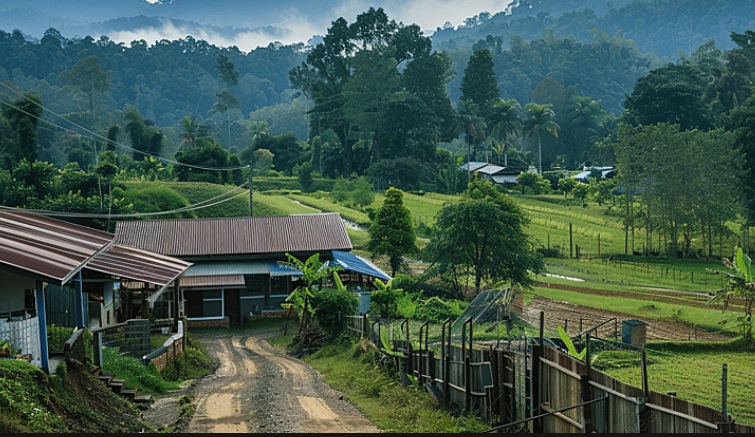
Image from https://png.pngtree.com/thumb
Cultural Legacy and Contemporary Life
These villages reflect Bangkok’s early multicultural history. Malays contributed to the city’s development through labour, farming, and trade, despite their origins as captives (chaloei).
They helped build infrastructure and boost agriculture on the capital’s outskirts.
Today, many retain mosques, over 190 in Bangkok overall, with dense concentrations along former Malay settlement corridors, cemeteries, traditional homes, and cultural traces like specific recipes (e.g., localised mussaman curry or festive dishes).
The Bangkok Malay language has declined due to compulsory Thai education, nationalist policies (e.g., Phibun era), and urbanisation, but Islamic traditions remain strong.
Many now identify primarily as Thai Muslims while preserving Malay heritage, especially in Nonthaburi and Pathum Thani.
Urban growth has reshaped or absorbed many kampongs into the metropolitan fabric, with land sales for development and infrastructure changes (roads replacing canals).
Yet semi-rural pockets persist, offering glimpses of traditional life amid condos and highways.
Recent cultural interest—exhibitions like “From Patani To Bangkok,” films, books, and walking tours—highlights this hidden history and explores themes of displacement, resilience, and identity.
Visiting the Heritage
For visitors, Thonburi’s canal-side communities (e.g., around Bang O or Ban Suan Phlu mosques), eastern suburbs along Saen Saep, or areas in Min Buri/Nong Chok provide authentic insights.
Respect local customs, especially around mosques, and consider guided tours or boat rides on historic canals for context. These sites underscore Bangkok’s layered identity as a crossroads of Thai, Malay, Cham, Chinese, and other influences.
Bangkok’s Malay kampongs stand as living testaments to centuries of movement, adaptation, and endurance, older urban Malay enclaves than many in Malaysia itself, born not from colonial planning but from the turbulent forging of modern Siam.
Their story enriches Thailand’s capital with a profound, often overlooked Southern heritage. – June 10, 2026