


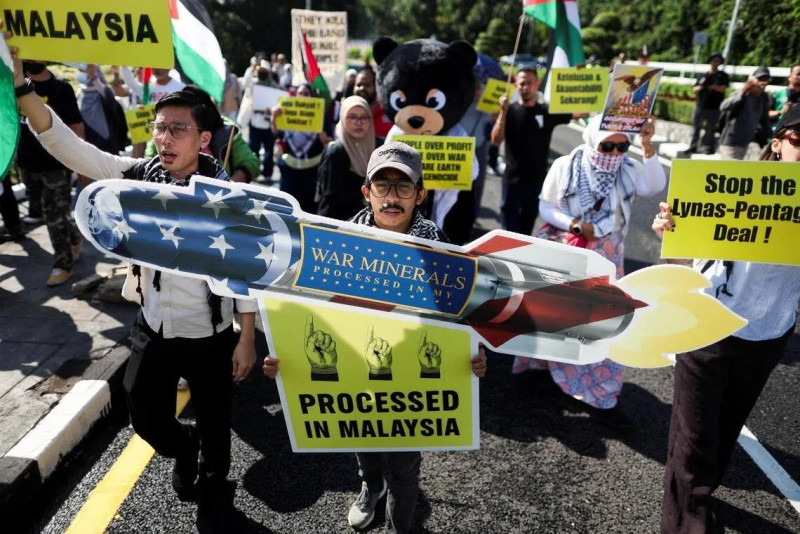
MEMBERS of Parliament have urged the government to publicly clarify its position over concerns that rare earth materials processed in the country could enter the United States defence industry supply chain through a proposed agreement between Australian miner Lynas and the Pentagon.
The issue emerged after Lynas, which operates a rare earth processing facility in Gebeng, Pahang, signed a binding letter of intent with the US Department of Defense in March for a proposed four-year supply agreement worth US$96 million.
The Straits Times cited that under the proposed arrangement, the Pentagon would purchase light and heavy rare earth oxide products from Lynas to strengthen US national security and supply chain resilience.
The agreement has placed Malaysia’s rare earth sector under international scrutiny, with lawmakers questioning whether materials processed domestically could eventually be used in US military applications.
Rare earth elements are considered critical minerals due to their role in advanced technologies, including electronics, electric vehicles, renewable energy systems, radar equipment and precision-guided defence systems.
The development has also raised concerns over whether Malaysia’s involvement in the global rare earth supply chain could create diplomatic complications for Putrajaya’s carefully balanced foreign policy, particularly regarding its longstanding support for the Palestinian cause.
The Parliamentary Select Committee on International Relations and International Trade has called on the government to clarify its position on the matter by the end of July.
The committee, which conducted a hearing on the issue on July 16, also recommended that Putrajaya establish a clearer foreign investment policy framework for strategic minerals to protect Malaysia’s interests, sovereignty and international reputation.
“The meeting was held to examine and assess the impact of the supply agreement, which is seen as potentially damaging Malaysia’s reputation as a staunch supporter of Palestine, founded on the principles of humanity and universal justice,” the committee said.
The hearing involved lawmakers, Lynas interim chief executive officer Pol Le Roux, as well as representatives from environmental and civil society organisations including the Malaysian Consultative Council of Islamic Organisations, Sahabat Alam Malaysia and Greenpeace Malaysia.
Greenpeace Malaysia representative Adam Azlan said rare earth minerals processed in Malaysia should not contribute to conflicts, alleged atrocities or violations of international humanitarian and human rights law.
“We need Malaysia to ensure due diligence under international law and standards for companies operating within our jurisdiction – that they do not contribute to rights violations,” he said.
“We need the government to have stronger oversight, transparency and accountability in our supply chains. All this to safeguard Malaysia’s sovereignty.”
The debate comes as Malaysia’s role in the global rare earth industry grows in strategic importance.
The country is estimated to have about 16.1 million tonnes of non-radioactive rare earth resources, making it an increasingly significant player in global competition for critical minerals.

The Lynas Advanced Materials Plant in Gebeng, near Kuantan, is currently the largest rare earth processing facility outside China.
The 100-hectare plant processes rare earth materials imported from Lynas’ Mount Weld mine in Western Australia, including neodymium-praseodymium, which is used in high-strength permanent magnets.
The facility has also expanded its production capabilities, including separated dysprosium, a heavy rare earth element used in electric vehicles, wind turbines and defence-related technologies.
The United States has identified rare earths as a national security priority, citing concerns over dependence on foreign processing capacity, particularly in China.
In October 2025, Malaysia and the United States signed an agreement aimed at promoting cooperation and investment in rare earth exploration, extraction, refining, manufacturing and recycling.
Under the agreement, Malaysia committed to facilitating cooperation with US companies and not restricting exports of critical minerals or rare earth magnets to the US.
The latest controversy highlights the growing challenge facing Malaysia as it seeks to attract investment in strategic minerals while balancing economic opportunities, environmental concerns and its independent foreign policy position. - July 18, 2026










