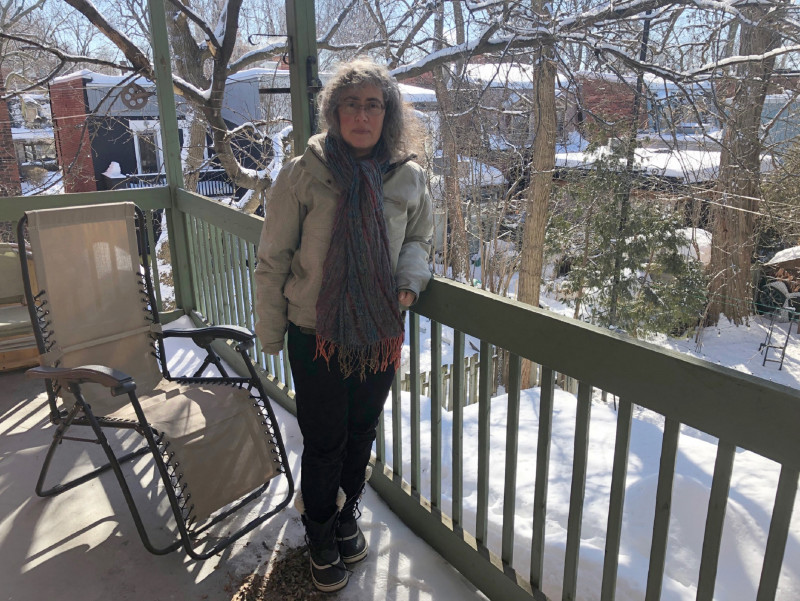
DIFFICULTY breathing, concentrating and even walking: five months after being diagnosed with Covid-19, Violaine Cousineau continues to suffer severe symptoms that prevent her from resuming normal life.
"I feel like I've aged 30 years in a few months," the 47-year-old Canadian tells AFP.
Sitting in her kitchen and wearing a mask, Cousineau gestures with her hands as she speaks, as if to accentuate her words as her voice has been reduced to a whisper.
"I don't recognize myself, my family doesn't recognize me either. I'm not the person I was," says the Montreal resident, noting that she walks with a cane to avoid falling.
A mother of two girls aged 12 and 15, she is one of hundreds of expected patients of a new clinic in Montreal specializing in long-term health impacts of Covid-19, or "long Covid."
She had no preexisting health problems and even enjoyed "super cardio" hiking on nearby mountains on weekends.
After contracting the illness in October, she spent a trying first week, including being bedridden for three days.
"I could never have thought for a fraction of a second that it would go further than that," she says.
Now, cooking has become difficult -- and going down the stairs? "I'm going to be slammed for the day," laments the literature teacher who is no longer able to turn the pages to read a novel or return to work.
"Everyday life has been turned upside down," she says. "It's the ordeal of a lifetime."
10 to 30 percent afflicted
A significant number of patients who contract the novel coronavirus mysteriously suffer debilitating symptoms long after others recover. The European branch of the World Health Organization says the seemingly chronic condition must be "of utmost importance" to health authorities around the world.
In Quebec, which has recorded more than 294,000 cases of the coronavirus, "it could be 10 to 30 percent of patients who have complications," says Emilia Liana Falcone, director of the new clinic set up by the Montreal Clinical Research Institute (IRCM), which is affiliated with the University of Montreal.
Opened in February, the clinic's doctors aim to understand the long-term complications of Covid and their duration in order to then determine the causes and develop treatments.
Falcone says there are patients still showing symptoms one year after getting infected.
The clinic, she says, has so far examined about 15 patients and expects several hundred more with complications that can affect people "aged 19 years as much as those 69 years old."
"Fatigue is definitely very common," says the infectious disease specialist, as is shortness of breath, muscle pain or sleep disorders.
Cousineau says she "does not expect miracles." Blood tests, cardiac ultrasound, chest x-ray: all tests have come back normal.
"I almost feel like a mutant, a new species which has appeared and which must be successfully decoded," she says with a smirk.
The only relief from her symptoms: spending very long hours in the brisk air of the Canadian winter, outside the city.
Anne Bhereur, 44, another patient at the clinic, finds it "very reassuring to be supported by people who are competent and interested in understanding what is happening."
"What is it that makes breathing so difficult?" wonders the family doctor afflicted with long Covid, explaining in a whisper that her colleagues are "just as baffled" by her symptoms.
After contracting Covid-19 in December at the hospital where she worked in palliative care, Bhereur thought she would return ten days later "with immunity against the virus, while being a little safer."
But she still feels very tired and has difficulty breathing and concentrating, forcing her to break up each daily task.
"It takes me 30 minutes to go around the block when normally it would not even take 10," she says, adding that she tries "hard to remain optimistic."
She adds: "Laughing or crying, I become too short of breath, so we take things one day at a time." – ETX Studio, March 15, 2021