Animals

Endangered Australian songbird 'losing its song'

Scientists estimate just a few hundred regent honeyeaters remain in the wild

Updated 5 years ago · Published on

Endangered Australian songbird 'losing its song'
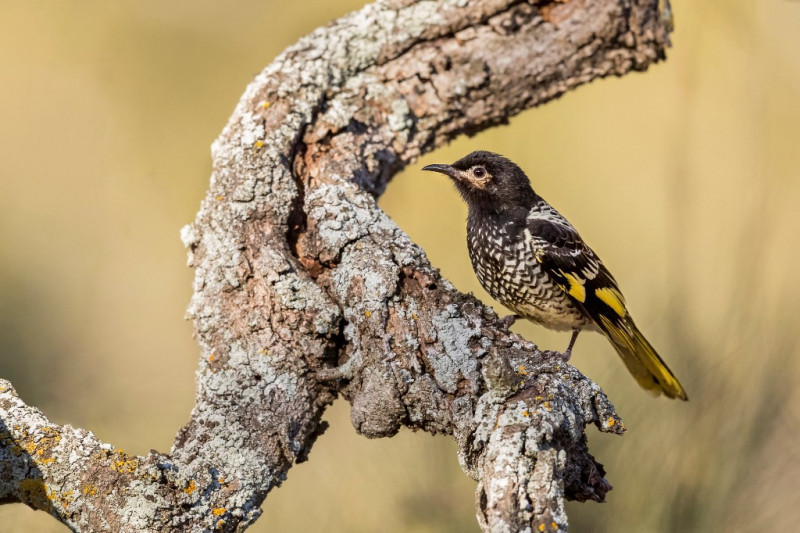
This undated handout photo received from Australian National University on March 17, shows a rare Australian songbird, a female regent honeyeater, at the Capertee National Park in New South Wales. – AFP pic, March 17, 2021

SYDNEY – Australia's endangered regent honeyeater bird is losing its song, a sign that it could be nearing extinction, scientists warned in new research released on Wednesday.

A rapid decline in the rare songbird means its young are struggling to learn mating calls as adults disappear, according to researchers at the Australian National University.

Male regent honeyeaters sang rich, complex tunes in more populated habitats, but resorted to simplified songs elsewhere, the scientists wrote in a study published in the peer-reviewed journal Proceedings of the Royal Society B.

Lead author Ross Crates said the findings were a "major warning sign the regent honeyeater is on the brink of extinction" – and the loss of song knowledge could also reduce chances of mating.

"It could also be exacerbating the honeyeater's population decline, because we know a sexy song increases the odds of reproduction in songbirds."

Scientists found 18 regent honeyeaters, or around 12% of the total remaining male population, who could only mimic other species' songs – not their own.

"This lack of ability to communicate with their own species is unprecedented in a wild animal," study co-author Dejan Stojanovic said. 

"We can assume that regent honeyeaters are now so rare that some young males never find an older male teacher."

Scientists estimate just a few hundred regent honeyeaters remain in the wild.

The rare bird, with its black and yellow markings, was once found across much of eastern Australia but is now largely confined to eucalyptus forests in the country's southeast.

The study also found regent honeyeaters born in captivity have different songs that could reduce their attractiveness to wild birds.

The scientists now hope to teach the captive birds to sing like their wild counterparts, by playing them audio recordings. – AFP, March 17, 2021


Related News

Malaysia / 2mth

Penang-born woman dies in Perth after alleged domestic violence assault

Malaysia / 3mth

Rocky’s death: I had no intention to harm any animal – says man at the centre of storm

Malaysia / 3mth

Tengku Permaisuri Selangor: ‘No form of cruelty to animals will be accepted or tolerated’

Malaysia / 7mth

Malaysia, Australia back Pope Leo's call for peace, urge dialogue to end global conflicts

Education / 10mth

Legal board withdraws recognition of law degrees from 2 Australian, NZ universities

Opinion / 1y

The man who gave Malaysia its heart in a jungle — remembering Tan Sri Vic M. Hutson

Spotlight

Malaysia

Anwar receives special recognition as 10,000 Muslims gather in Putrajaya

Malaysia

Video of elderly man being assaulted goes viral on social media

Malaysia

The wide reach of corruption and organised crime in the country

Malaysia

Malaysia pushes to give smaller economies stronger voice in Asia-Pacific trade – Anwar

Malaysia

No tsunami threat to Malaysia after 5.4-magnitude earthquake hits Banda Sea

Malaysia

Who is calling the shots in Negeri Sembilan as Ismail’s position comes under scrutiny?

Opinion

Ayob Khan: When the uniform comes off, the principles remain

Malaysia

MySiren to send emergency alerts to compatible phones nationwide from Nov 29 test

You may be interested

Our Planet

Beaver Supermoon lights up November skies, begins four-month celestial spectacle

Health

Selangor records 18,451 haze-related illnesses, with Petaling clinics hardest hit

Community

BOH contributes RM50,000 to Malaysia’s homegrown cancer vaccine research

Events

Seven companies selected for RM15m corporate innovation programme

By Alfian Z.M. Tahir