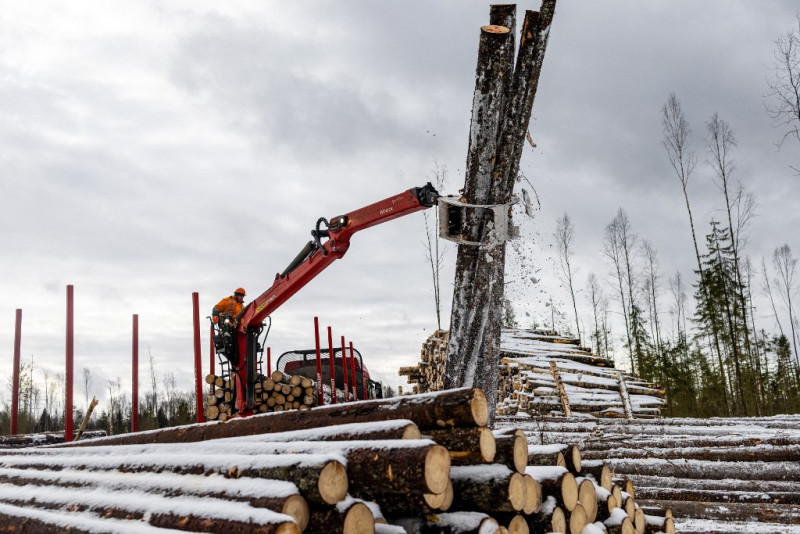
VOLOGDA – In a dense forest northeast of Moscow, logging machines cut down rows of trees as Russia taps foreign demand for its wood as part of efforts to reduce its dependence on oil exports.
Nowhere is this more evident than in Vologda, a region 500km northeast of the Russian capital, where forests of birch and pine stretch as far as the eye can see.
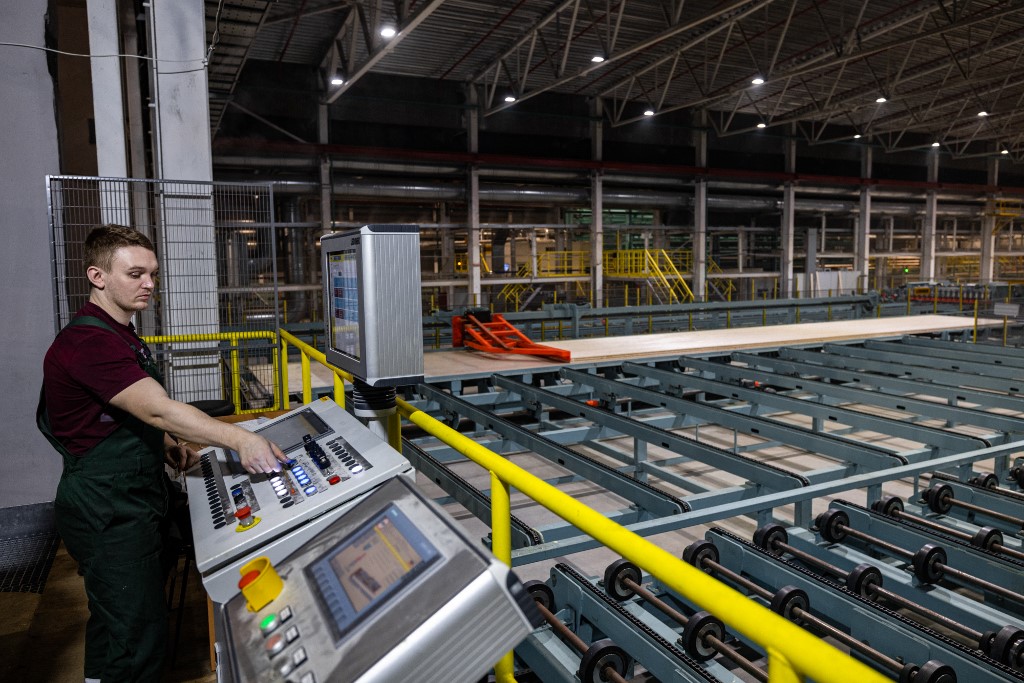
Tracked vehicles equipped with booms that can grab and cut trees are used by the Segezha group, which turns the wood into planks at a nearby factory.
For Segezha vice-president Dmitry Rudenko, the scene illustrates a turning point for Russia's timber sector.
"What we're seeing today is the rise of the timber construction industry. It is Russia's future without a doubt," he said at the Moscow offices of the Sistema holding firm, of which Segezha is a subsidiary.
Russia is home to one-fifth of the world's forest and further exploiting this resource could help the country cut down its economic reliance on oil and gas.
Hydrocarbons account for half of Russian exports by volume while wood and its derived materials represent about three per cent.
It could also help Russia improve its environmental image as wood is a much greener construction material than concrete, which releases lots of carbon into the atmosphere during its production.
Trees can be replaced, though environmental groups are sceptical about Russia's record on that front.
'Bright future'
Segezha was already a leader at home and abroad in paper-based packaging and various wooden construction products.
Now it has launched the first factory in Russia to manufacture cross-laminated timber (CLT) panels, which thanks to the layers of wood being glued at right angles, are rigid enough to build multi-storey buildings.
The use of CLT for buildings is increasingly popular in Europe but still niche in Russia, where firms hope it will be approved by regulators in the coming months.
In the meantime, Segezha is busy exporting to Germany, Austria, Italy and Japan.
"Biomaterial, including wood, has a bright future. Consumer demand for ecological and natural products is increasing," said Marina Zotova of the WhatWood analysis firm.
"The quality of Russian timber is on par with that of Finland and the United States," she added, describing the texture of some Siberian wood as "breathtakingly beautiful."
Andrei Frolov, vice president of the Russian timber industry union, said that the sector has "good prospects, particularly in the foreign market."
But he noted that massive investments would be necessary for the timber industry to compete with the oil and gas industries.
One way that Russian authorities hope to encourage the development of the industry is to ban the export of certain types of logs from 2022 and instead focus on processing the lumber at home in order to ship wood-based materials that have more value.
Russia is a global leader in exports of raw wood.
'One cut, another planted'
In Vologda, sporting a red beard and bottle-green uniform, site manager Ilya Moskalyov said that all felled trees – some of which are seven decades old – are ultimately replaced.
"Wood is a renewable building material so long as forests are managed properly. One is cut, another is planted – it's an inexhaustible source," said Vologda plant manager Konstantin Pastukhov.
This sentiment is progress from the 1990s when large swathes of trees were levelled illegally, said Alexei Yaroshenko of the Greenpeace advocacy group.
But environmental groups are sceptical of claims that all felled forests are replanted, and are calling for tighter regulation of the industry.
The World Wildlife Federation just this week urged the Russian authorities to make public data on foresting to guarantee greater transparency.
"On paper, it's all restored – but not in reality," Yaroshenko of Greenpeace said.
"There's no follow up". – AFP, March 24, 2021