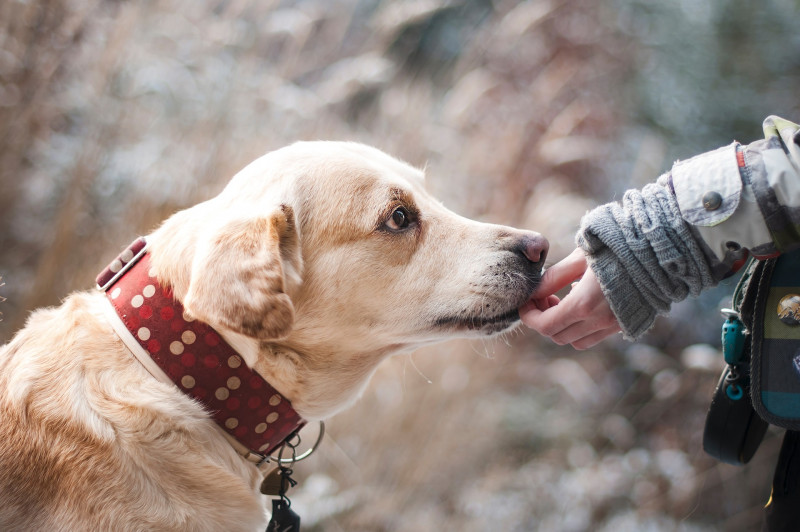
DOGS are well known for their keen ability to engage with subtle human cues, like following hand signals or immediately recognising when someone is talking to them.
But whether they are born with these talents, or learn over time by trial-and-error has remained a fuzzy area among scientists.
A new study published Thursday in Current Biology found that genetics play an outsized role in canines' interactive skills with people, and some start out life at a more advanced stage than others.
Emily Bray, a researcher at the University of Arizona and the paper's lead author, told AFP that a key test scientists use is to see how well animals comprehend human finger-pointing gestures.
Past studies have shown dogs understand these far better than chimpanzees, our closest relatives in the animal kingdom.
Some argued these traits arose as a result of domestication, while others believed that since dogs live in close contact with humans "they kind of have a front row seat to all our interactions," said Bray.
To resolve this question, Bray and colleagues realised they needed to look at puppies, who have had much less exposure to people than adult dogs.
They teamed up with Canine Companions, a service dog organisation that provided them 375 goldadors, labradors and golden retrievers.
"We knew how they were related to one another, so that allowed us to look at that genetic piece," said Bray.
Over the course of a few years, the team ran a set of standardised tests on the pups when they were just eight weeks old and still living with their littermates rather than humans.
In one, a puppy would enter an experiment area where a treat was available under one upturned cup but not another.
Bray initiated the test by saying "Puppy, look!" while making eye contact and pointing at the cup with the treat.
The pups chose the right cup 67% of the time, well above 50% which would be expected if they did not understand.
Another test involved Bray placing a small box next to the container with the treat, and the pups were successful in understanding the clue 72% of the time.
The puppies' performance did not increase significantly over repeated experiments, reinforcing that the skills are more innate than learned.
To exclude the possibility the pups were relying on their sense of smell, the team ran an experiment where Bray remained motionless and the pups were left to search for themselves.
In this test, they were successful only half the time, which corresponds to chance.
The team also carried out so-called "human interest" tests on the pups, to see how they would engage with a person on their first prolonged contact.
The puppies became excited and approached Bray when she used a high-pitched voice mimicking the tone a parent adopts with a young child, and read from a standard script that began: "Hi pup! Are you a good puppy? Yes you are."
Genome analysis expected
Not all the pups were as adept as one another, and a statistical analysis showed that genetic factors accounted for 43% of the variation in ability between the pups – comparable to the genetic basis for intelligence in humans.
Bray said the findings helped shed light on dogs' past as they were domesticated from wolves around tens of thousands of years ago.
But whether our ancestors bred dogs for their specific skill sets, or whether they simply bred dogs that were friendly and these individuals were more inclined to follow our lead still isn't clear.
Future investigations to determine which genetic markers correspond to higher social skills can also have practical applications, she added.
"These dogs grow up and have a job that they may or may not be successful at, so we can start to ask questions about what makes a successful service dog or successful working dog," she added. – AFP, June 4, 2021