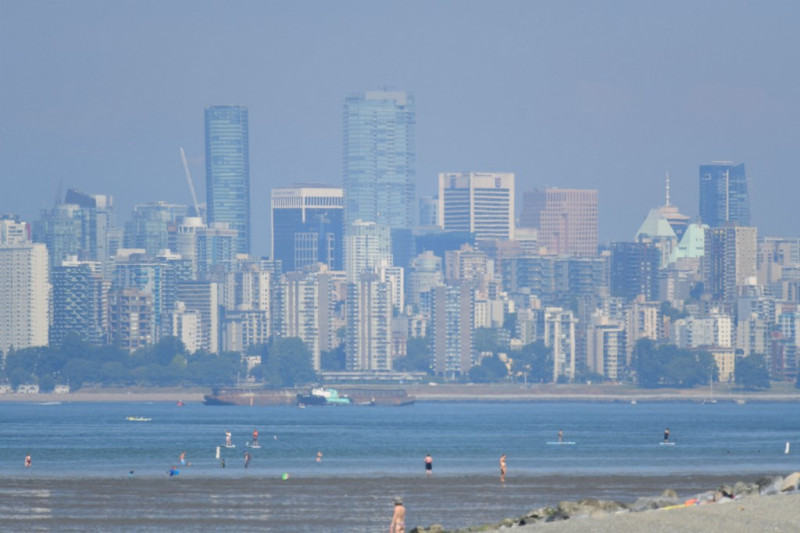
THE western United States and Canada would likely have experienced a heat wave in the past week even without climate change. But the scale and severity of the record-breaking temperatures were undoubtedly multiplied by the changes to our atmosphere, experts say.
The US states of Washington and Oregon, as well as British Columbia in Canada, boiled this week in all-time high temperatures that have caused dozens of deaths.
"This is one of the most extreme heat waves that we have seen on Earth, in many years, anywhere, in terms of the deviation from the typical conditions in this particular part of the world," said Daniel Swain, a climate expert at UCLA, noting that temperature records are rarely broken by "more than a degree."
"In this case, those records were obliterated," he said. "It's really the magnitude and the persistence of this one that is just genuinely shocking."
Canada set an all-time record on Tuesday. In Oregon, temperatures were higher than the maximum recorded in Las Vegas, in the middle of the Nevada desert.
And all this in a region with a normally temperate climate at this time of the year.
The phenomenon causing the scorching heat is called a "heat dome." Hot air is trapped by high pressure fronts, and as it is pushed back to the ground, it heats up even more.
"It's sort of like a bicycle pump," said Philip Mote, professor of atmospheric science at Oregon State University. "If you compress air into a bike tire, it warms the air."
The condition also prevents clouds from forming, allowing for more radiation from the sun to hit the ground.
Such conditions are not unheard of: "The pattern was similar to how we always get our heat waves," Karin Bumbaco, a climatologist at the University of Washington, told AFP. "We've seen that pattern before, but it was just much stronger than usual."
Climate like 'steroids'
So what is causing the precedent-shattering highs?
"A world without climate change would have still had a heat wave in the Pacific Northwest. It just would have been not quite as record-setting," said Zeke Hausfather, a climate expert at the Breakthrough Institute.
"Climate is like steroids for the weather," he said "If a baseball player or Olympic athlete is taking steroids, they're still going to perform better some days and worse some days, but on average, their performance is going to go up. And so climate is doing something similar to the weather. That makes it more likely to experience these sort of extremes."
So-called "attribution studies" will be conducted to determine the exact causes of the event.
But "I think it's safe to say that there's at least some components of global climate change that contributed to this event," said Bumbaco.
Temperatures are generally higher in this region, which has warmed by around three degrees Fahrenheit in the past 100 years, so it makes sense for records to be broken little by little.
However, "it is very possible that climate change increased this heat wave to an even greater degree" than that, said Swain, the UCLA expert.
For example, the drought that has plagued the region for weeks may have bolstered the heat dome because the energy of the sun's rays is no longer being used to evaporate water, so instead it warms the atmosphere more.
And climate change is already "increasing the severity of drought" in parts of western North American, said Swain. "The answer to the question of whether it would have happened to this extent without climate change is clearly no."
Adaptation
It is hard to predict just how often such heat waves will occur again.
"This particular event was so extreme that it will remain unusual, even in a warming climate," said Swain. "But it has gone from the realm of being essentially impossible to being something that we may well see again."
"The bad news is that even if we could wave a magic wand and get all our emissions to zero tomorrow, the world isn't going to cool back down," said Hausfather.
"We're stuck with the warming... And so we need to be prepared for these sorts of events to be more frequent."
Experts insist on the need to adapt in the medium term: by equipping populations with air conditioners (even if they release harmful emissions in the long term), by rethinking the structure of buildings so that they reflect rather than retain heat, and by planting vegetation.
But all are unanimous: "In the longer term, obviously, the best way to prevent these things from happening in the first place, or to reduce how much worse they could get, is to reduce global emissions of greenhouse gases," said Mote. – AFP, July 1, 2021