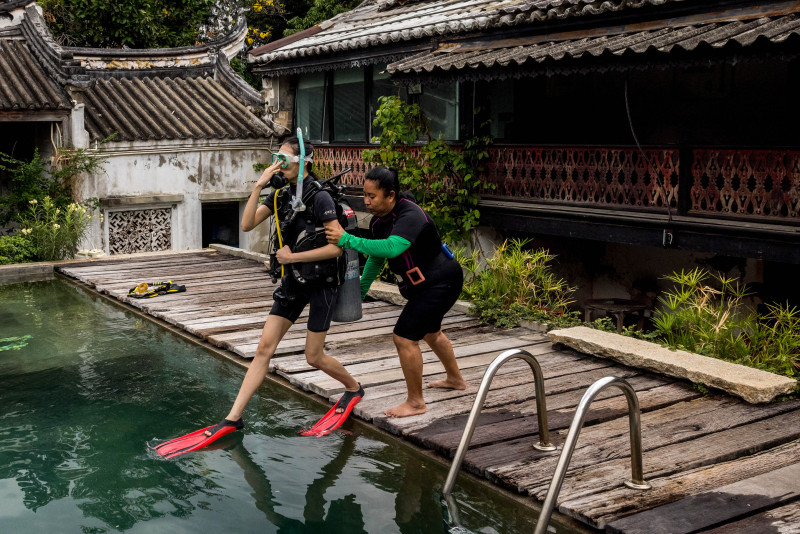
BANGKOK – A 200-year-old Chinese mansion in Bangkok's heart isn't an obvious place for a scuba school, but in a city relentlessly demolishing its architectural heritage the business is helping preserve the historic home.
Dive instructor Poosak Posayachinda's family has owned the traditional teak-walled So Heng Tai for eight generations, but it lives on thanks largely to his decision to convert it into a scuba academy.
The survival of the building, originally built as a home and office for the family business trading birds' nests with China, is a rare success story in a city that harbours little sentiment – or legal protections – for historic architectural gems.
"It's because people want to make more money – that's the bottom line," Bangkok-based American architect Bill Bensley told AFP.
The city's breakneck reinvention over recent years has seen gleaming malls and flashy condos fly up, and buildings like the art deco Scala movie theatre and 1920s British embassy come down.
Thai law only protects properties over 100 years old and there is limited political enthusiasm for safeguarding old architecture at the expense of profitable development.
For families with historic properties, the annual costs of maintenance can be a huge liability, according to historian and archaeologist Phacha Phanomvan.
"We don't have a lottery fund or trust body that comes in to save heritage," she said.
So in 2004 Poosak installed a four-metre-deep pool in the So Heng Tai courtyard, subsequently teaching more than 6,000 students.
The diving school has helped pay the bills on the property's upkeep, which Poosak estimates at up to US$25,000 (RM105,000) a year, but maintenance is a struggle.
"On a rainy day you find lots of water spots. Sooner or later we will have to do the whole roof again and that's a lot of money," Poosak told AFP.
Historical theft
While the culture ministry keeps a national heritage database, Phacha said many properties are not registered and fall through the cracks.
"For individual owners without state assistance... it's better for them to sell the property. Sell the individual building and then sell the (land)," she said.
Adding to the challenge is a growing collectors' market for teak from Thai wooden houses, she said – some are even dismantled, relocated, and reassembled to become boutique hotels elsewhere.
"You want to keep these properties where they are... You're essentially robbing Bangkok of its (history)," she said.
Photographer Ben Davies spent five years documenting neighbourhoods for his book Vanishing Bangkok, an experience that left him despondent.
"Something like (30-40%) of the buildings and communities I photographed had either disappeared or changed virtually beyond recognition," he told AFP.
And in the rush to develop, Davies says it is unclear how much of Bangkok's heritage will remain in a decade.
"I have a horrible feeling that one day Bangkok will be, outside of its temples and few palaces, (a) unrecognisable but (b) have lost so much of its identity and character so it will look like any other megacity around Asia," he said.
A glimmer of hope?
Elsewhere in the region offers Thailand possible solutions, notably Singapore which has won praise since the late 1980s for its heritage protection efforts.
Its strategy examines the entire city-island holistically with conservation going hand-in-hand with planning, says Yeo Kang Shua, an architectural history expert at the Singapore University of Technology and Design.
Underpinning the scheme is the "three R" principles: maximum retention of buildings, sensitive restoration and careful repair.
"In the 1980s a lot of owners deemed it a death sentence for their properties to be given conservation status, but today because of the rarity of such buildings in Singapore, the real estate prices are... enormous," he told AFP.
Despite the challenging environment, there are some signs of change in Bangkok.
In recent years a prominent Sino-Thai business family renovated dilapidated Chinese 1850s warehouses, turning them into the Lhong 1919 "riverside heritage destination".
It now houses a shrine and has become a space for exhibitions, concerts, pop-ups, cafes and food vans – and there are plans for a wellness resort.
Back at So Heng Thai, Poosak takes his students through their paces.
Channelling the attitude of his ancestors – who came to Thailand with "one pillow and one mattress" – he's determined to save his family home.
"If someone comes to give me an offer, the answer is no, simple as that, no matter how much it is," he said. – AFP, March 13, 2022