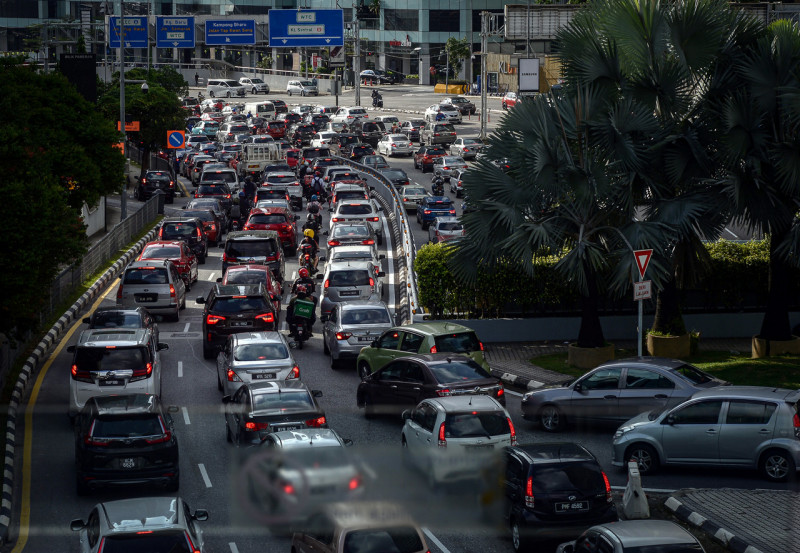
KUALA LUMPUR – Leaving her house in Nilai, Negeri Sembilan, as early as 6.15am for the 60-kilometre commute to the office in the federal capital here has become the routine for civil servant Aida Ismail, 35.
Even a slight delay will see her arriving at her office later than 9am. In all, she spends about six hours on the road daily travelling between her house and the office. She arrives home at 9pm, when her only child is usually fast asleep.
That has been Aida's routine since last April when the country entered the endemic phase.
In a month, she is on the road for about 120 hours, which is equivalent to five days, a situation which is experienced by thousands of other workers.
"There are times when I feel so stressed – I heard whispers, that I felt like crashing into the car in front," said the woman, who complained of her hand and lower back feeling numb and aching due to long hours of driving.
Universiti Malaya senior consultant psychiatrist Associate Professor Dr Muhammad Muhsin Ahmad Zahari, said continuously getting stuck in traffic jams could contribute to mental health disorders leading to chronic stress such as depression and anxiety.
"The stress will increase if the person is often late for work and is reprimanded or given warnings by the employer, which in turn affects his/her emotion and work productivity," he said.
Dr Muhammad Muhsin said if not addressed, the matter could also lead to the person having high blood pressure, heart disease, and diabetes. These conditions would get more severe without a healthy lifestyle.
Therefore, he said, time management is important to avoid the rush.
A specialist at the Psychology and Human Wellbeing Research Centre, Universiti Kebangsaan Malaysia, Professor Dr Rozmi Ismail, expressed the importance of employers implementing flexible working hours. The goal here is to remedy the situation and create a healthier work environment.
"This means having staggered working hours so that employees do not come to work and leave at the same time.
“For example, having a shift system that starts at 8am to 5pm and the second shift starting at 10am to 8pm. Alternatively, we can also implement a rotation system that requires employees to be present in rotation in the office,” he said.
Based on media reports last month, Deputy Minister of Human Resources Datuk Awang Hashim said employees in the country who want to work on a flexible basis could apply for Flexible Working Arrangements (FWA) with their respective employers under the amendment to the Employment Act 1955, which will come into force on September 1.
The FWA application must be made in writing and can cover changes in working hours, working days, and also the place of work.
Rozmi said implementing flexible working hours could help increase workers’ productivity and help reduce the risk of stress. It would also maintain quality of life and mental well-being.
“After all, we went through it during the implementation of the movement control order which required almost all organisations to adopt the work-from-home concept.
"This not only allows workers to give full attention to the tasks given because there is no need to commute to work. This can save time and workers can be more productive," he added.
He said civil servants should also be considered to work flexible hours according to the suitability of the department.
Rozmi said having flexible working hours also allowed for better time management for workers. This would enable them to better arrange their time without neglecting their responsibilities at home, especially for those who are married.
"However, we must also remember that not all types of work are suitable to be done outside the office. But if there are issues such as unsatisfactory quality of work, employers can do regular monitoring by developing an effective system,” he said. – Bernama, July 8, 2022