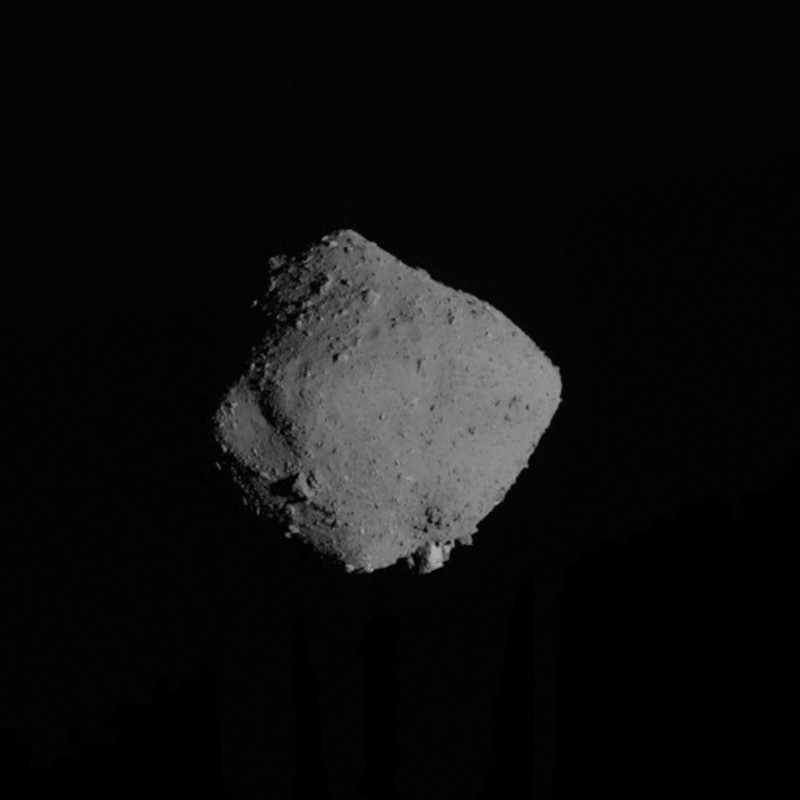
TOKYO – Specks of dust retrieved by a Japanese space probe from an asteroid some 300 million kilometres from Earth have revealed a surprising component: a drop of water, scientists said on Friday.
The discovery offers new support for the theory that life on Earth was seeded from outer space.
The findings are in the latest research to be published from the analysis of 5.4 grammes of rocks and dust gathered by the Hayabusa-2 probe from the asteroid Ryugu.
“This drop of water has great meaning,” lead scientist Tomoki Nakamura of Tohoku University told reporters ahead of the research's publication in the journal Science on Friday.
“Many researchers believe that water was brought (from outer space) but we actually discovered water in Ryugu, an asteroid near Earth, for the first time.”
Hayabusa-2 was launched in 2014 on its mission to Ryugu, and returned to Earth's orbit two years ago to drop off a capsule containing the sample.
The precious cargo has already yielded several insights, including organic material that showed some of the building blocks of life on Earth, amino acids, may have been formed in space.
The research published Friday says the team found a drop of fluid in the Ryugu sample “which was carbonated water containing salt and organic matter”, Nakamura said.
That bolsters the theory that asteroids like Ryugu, or its larger parent asteroid, could have “provided water, which contains salt and organic matter” in collisions with Earth, Nakamura said.
“We have discovered evidence that this (process) may have been directly linked to, for example, the origin of the oceans or organic matter on Earth.”
Nakamura's team, comprising about 150 researchers – including 30 from the United States, Britain, France, Italy, and China – is one of the largest teams analysing the sample from Ryugu.
The sample has been divided among different scientific teams to maximise the chance of new discoveries.
Kensei Kobayashi, an astrobiology expert and professor emeritus at Yokohama National University who is not part of the research group, hailed the discovery.
“The fact that water was discovered in the sample itself is surprising,” given its fragility and the chances of it being destroyed in outer space, he told AFP.
“It does suggest that the asteroid contained water – in the form of fluid and not just ice – and organic matter may have been generated in that water.” – AFP, September 23, 2022