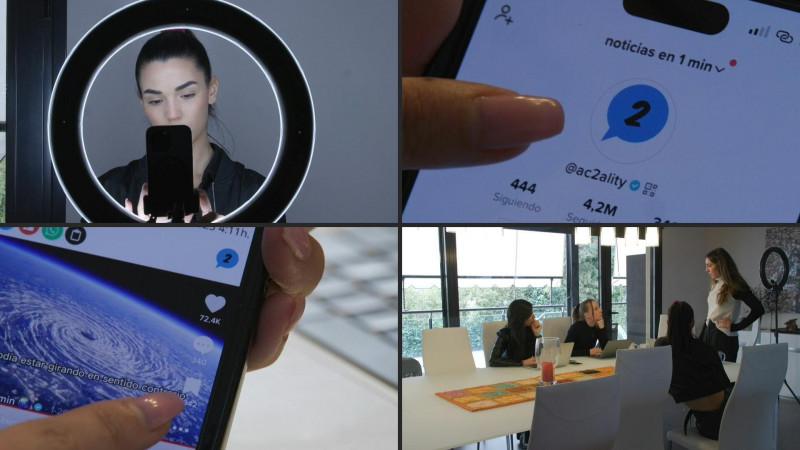
IN the suburbs of Madrid, four young women are hard at work creating videos summarising the news that is viewed every day by millions of people on TikTok.
They are part of a growing army of young people making content about current events which attract more viewers on social media than videos published by the traditional media.
The idea emerged when two of the women were studying in London between 2016 and 2020 as Britain was preparing to leave the European Union.
"We would read a bunch of articles but we weren't able to get a broad understanding" of the topic, said 26-year-old biotechnology graduate Gabriela Campbell.
"We thought if it's hard for us, there must be more people like us too," she told AFP.
So the pair joined forces with two other friends to launch an account on TikTok called "ac2ality" in June 2020, just as the popularity of the Chinese short-video sharing app was soaring among young people.
Nearly three years on, the account has 4.3 million followers – more than the majority of major media outlets.
That makes ac2ality the top news account in Spanish on TikTok, according to the University of Oxford's Reuters Institute for the Study of Journalism.
The four do not consider themselves journalists, saying instead they "translate the news" in one-minute videos made with a smartphone and a circular light to ensure well-lit images.
Their video narrating the start of Russia's invasion of Ukraine on February 24, 2022, was seen over 17 million times.
Lighter tone
Social networks like YouTube, Instagram and TikTok have become the main source of news for young people, according to several studies, including one by Britain's media regulator Ofcom.
Some initiatives offering news content "designed by young people for young people", such as French firm Brut, have already become heavyweights, said Reuters Institute researcher Nic Newman.
Thanks to algorithms, news accounts run by individuals and "not necessarily companies" can now "reach huge numbers of people" on social media, he said.
In France, HugoDecrypte is one of the most followed news accounts on social media and has broadcast interviews with French President Emmanuel Macron and Bill Gates.
Its founder, 25-year-old YouTuber Hugo Travers, told AFP he knows "how to talk to a generation" that simply "tunes out" when news is presented in a more traditional format.
Susana Perez Soler, a journalist and digital communications expert at Barcelona's Ramon Llull University, said such accounts owe their popularity to their lighter tone, creative formats and short lengths.
In cases like ac2ality, they are providing a "summary" of the news and "not journalism", which requires "investigative work, finding sources and checking their reliability", she added.
‘I'm my own editor’
The millions of subscribers these accounts attract have aroused the envy of major media outlets which struggle to reach young people.
A large Spanish media firm made a bid for ac2ality but the four founders wanted to maintain their independence.
Co-founder Daniela Alvarez said "one of the keys" to ac2ality's success was "not being associated with the mainstream media" which can sometimes be "politicised" or burdened by cumbersome procedures.
Some journalists who work for traditional media outlets also run their own news accounts on social media.
Sophia Smith Galer, a 28-year-old British journalist with Vice News, has an account on TikTok where her videos on sexual health have been watched more than 130 million times.
"You don't have to convince a gate-keeping news editor why a story is important," she told AFP.
"I am my own editor on that," she said.
"What young people consider to be newsworthy is not necessarily what traditional news media think is newsworthy."
Those between 15 and 30 do still turn to traditional media in some cases, said the researcher, Newman.
"When you talk about something like Ukraine, a lot of young people don't want that presented to them by 18-year-olds," he said.
"They want the news presented by people who are actually in the war zone and really know what they're talking about." – AFP, March 26, 2023