RECORD-smashing Antarctic heatwaves, melting glaciers, wave after wave of drought and wildfire, and an unending string of megastorms: since the 2015 Paris deal the deadly effects of climate change have been ever more visible.
"The world has changed since Paris. It has changed for the worst," said Saleemul Huq, from the International Center for Climate Change and Development (ICCCAD) at the Independent University of Bangladesh.
"We're seeing right now the impacts of attributable human induced climate change."
Hotter and hotter
The five hottest years on record have all come since 2015; the World Meteorological Organization said last week 2020 was set to be among the three hottest years in history.
2016 remains the warmest year recorded, with temperatures 1.2C hotter than the historic average. (The Paris accord aims to limit warming to "well below" 2C and to 1.5C if possible).
2020 will make the hottest years list despite it being a year with the La Nina cooling weather phenomenon.
In 2019 most of Europe sweltered in a record-shattering heatwave.
Last June temperatures in the town of Verkhoyansk in Siberia topped 38C; in February researchers recorded a temperature of 20.75C in west Antarctica – both would be record highs.
Ice melts, seas rise
Such temperature anomalies are disproportionately affecting the poles of our planet.
In October, scientists registered the lowest Arctic sea ice extent ever, and multiple studies have shown how the Greenland ice sheets are melting at unprecedented rates.
The melted ice from glaciers raised global sea levels by 15 cm last century, according to UN experts. They warn as many as a billion people could have their way of life threatened by rising seas as soon as 2050.
Storm seasons
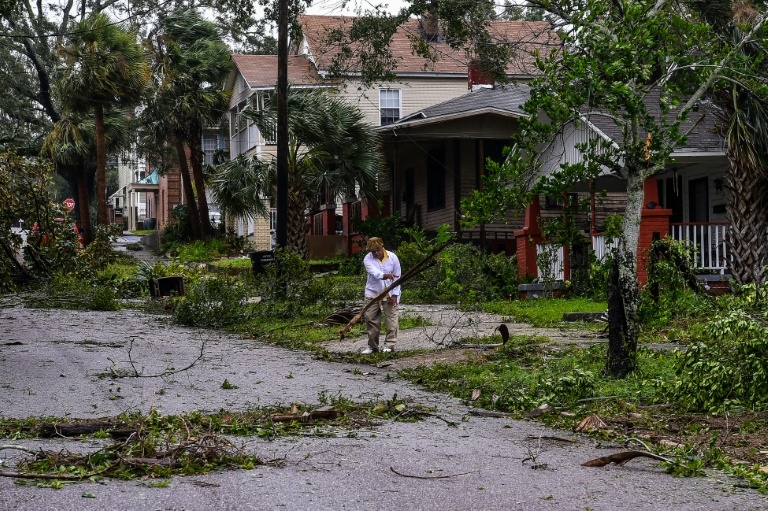
Higher and warmer seas mean more and stronger tropical storms.
"If you decrease the amount of Arctic sea ice you start warming up the Arctic and when you start warming up the Arctic you can start changing the circulation of the jet stream which brings weather to us," said Nathan Kurtz from Nasa's Goddard Space Centre.
Hurricanes and other cyclonic storms feed on warmer ocean water and while it is tricky to attribute a single weather event to global warming, the long-term trends are stark.
Each of the last five Atlantic hurricane seasons have seen above-average storm activity. For 2020, it was so intense that scientists ran out of Greek alphabet names for its 30 record storms.
Last year saw two cyclones ravage the coast of Mozambique, razing much of second city Beira, leaving more than 600 dead and hundreds of thousands homeless.
In 2017, much of South Asia and particularly Bangladesh was inundated with floodwaters dumped during a supercharged storm season.
Droughts, wildfires
At the other end of the weather spectrum, droughts are multiplying as temperatures continue their steady upwards march.
This has a profound impact on crop yields, as well as drinking water supply, as the nearly four million inhabitants of Cape Town discovered when the taps nearly ran dry in 2017 after three years of record drought.
The World Weather Attribution (WWA) service calculated that situations such as the threatened "day zero" in the South African metropolis were three times more likely due to climate change.
Long and large drought also creates the perfect, tinder-dry conditions of the mega blazes seen this year in eastern Australia, California and much of Siberia.
In Australia, the probability of intense fire seasons such as 2020's has increased 30% since 1990 due to warming, the WWA said.
In Siberia, fires are threatening the permafrost, which contains staggering levels of greenhouse gases.
Fires have also raged across the Amazon, mainly due to deforestation for agriculture. Scientists say more fires are likely due to climate change.
Food crises
Farming is a major source of greenhouse gas emission and its growing intensification of resource use threatens the global food chain.
Last year the UN's Food and Agriculture Organization warned that food production was "extremely sensitive" to climate change, which also threatens to reduce a major source of food as fish stocks diminish. – AFP, December 8, 2020