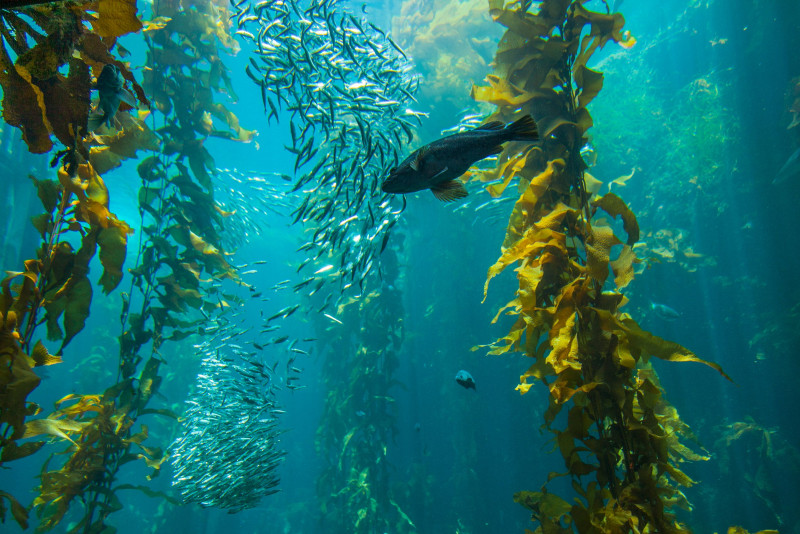
UNDERSEA kelp forests generate some US$500 billion in fishing revenue and other benefits while absorbing five million tonnes of carbon dioxide a year, scientists estimated in a study published on Tuesday.
The study published in Nature Communications offered a rare gauge of the contribution from the tall seaweed, which is threatened by climate change, valuing it at three times the amount previously thought.
The international team of scientists quantified the contribution of six kinds of kelp to fisheries production through the species they support.
They also calculated the benefits from kelp's role in nitrogen and CO2 removal.
"Globally, these kelp forests produce an estimated average of US$500 billion (about RM2.21 trillion) per year," they concluded, making them "over three times more valuable than previously acknowledged".
They found the kelp – whose support of numerous lifeforms was noted by Charles Darwin – sequester 4.91 million tonnes of CO2, thus removing planet-warming gas from the atmosphere.
Kelp are threatened by human-caused climate change, which warms the oceans. The International Union for Conservation of Nature has documented damage to them from marine heatwaves in recent years.
"Anything we can do to address the climate issue is going to have a positive impact on the kelp forest," co-author Aaron Eger, a marine scientist at the University of New South Wales and the Kelp Forest Alliance NGO, told AFP.
He also called for "stricter regulation on keeping waterways and oceans clean" of wastewater or agricultural pollution.
The researchers quantified kelp's role based on data for the number of tonnes of fish produced, calculating the amount produced sustainably each year per square metre and hence a market value.
They likewise calculated the kelp's capacity to store CO2, factoring into this the "social cost" of the planet-warming gas – a measure that takes account of its economic impact.
"This evaluation is not intended to commodify kelp forests, which support immense arrays of life and many other ecosystem services, but rather we hope to draw attention to their importance and inform policy and management decisions," the authors wrote. – AFP, April 24, 2023