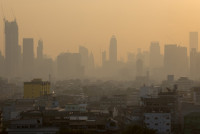
CITIES across Southeast Asia are turning to cooler rooftops, green spaces and other innovative solutions in the face of record heatwaves over 2022
As the year closes, 2022 is expected to be the equal fourth warmest year on record, despite natural climate drivers like La Niña dragging global temperatures down.
With over 15,000 dead from heat this year in Europe alone, cities are now grappling with an uncomfortable truth: hotter and longer heatwaves are now a fact of life.
“Extreme heat takes more lives in Australia than any other natural hazard,” Lauren Rickards from RMIT and Nigel Tapper from Monash University say. “Because of the high level of urbanisation, most of those deaths are in cities.”
Cities aren’t entirely at the mercy of the climate, though. Evidence shows that a variety of urban planning interventions can not only reduce the impact of extreme heat but benefit cities in other ways.
Switch air conditioning for fans
Air conditioning, the weapon of choice in developed nations, is getting complicated. “In face of urban warming, air conditioning remains almost the standard response in more developed nations, whatever the weather,” says Wanyu Shih, a researcher from the Ming-Chuan University.
Air conditioners and fans today account “for nearly 20% of the total electricity used in buildings around the world,” according to a report by the International Energy Agency. But that figure is set to explode in the coming decades as more people in India, China and Indonesia are able to buy air conditioners.
One way to contain that energy use is to focus on making air conditioners more efficient. But fans could replace air conditioning up to 19 out of 20 hot days in the countries where cooling is needed most.
Replace roofs to protect homes
Homes in developed nations might decide between fans and air conditioning in a heatwave, but for many people they aren’t even options.
Hot metal roofing amplifies heatwaves in slums, and residents escape by spending more time outside. They also take more baths and showers, placing further stress on drinking water supplies.
Authorities in the Indian city of Ahmedabad are trialling a programme to replace these hot roofs in the slums with cooler alternatives, lowering indoor temperatures by 2–5 degrees Celsius.
Cool cities down with plants
Cities are reaching for another solution beyond the home: plants. Although high-rise ‘sky gardens’ dominate public attention, parks and gardens at ground level also play a massive role in cooling cities.
It takes more than planting a few trees to protect cities, though. Green spaces can’t protect us from extreme heat unless they are resilient to heat themselves, and they need to be sited carefully to have the right effect.
“The trees left to protect the hotter cities of the future will depend on the planning actions we make today,” said Manuel Esperon-Rodriguez and Sally Power of Western Sydney University.
Take advantage of other green space benefits
Climate change is a famously wicked problem beset with cascading failures, but the solutions can also help us in unexpected ways.
Focusing on plants has reduced crime and supported local crafts in the Indonesian city of Surabaya, while Danish researchers have found access to green space improves kids’ mental health later in life.
But green space needs to be within a short walk in order for people to use and benefit from it, cautioned Kristine Engemann, a researcher at Aarhus University. “Sometimes we’re not so good at doing the things that are actually good for us.”
The co-benefits of green space aren’t just limited to social benefits: they can also help to protect us from other aspects of climate change.
China’s sponge cities, built from porous materials, combat flood risk and urban heat at the same time.
Describing one of these sponge cities, Bao-Jie He of Chongqing University said, “Zhuhai has constructed more than 115 square kilometres of sponge city infrastructure since 2016… The green-blue infrastructure development has been no impediment to the city’s continued growth.”
Options like these are attractive to cities looking to protect residents and take ownership of climate change adaptation. But they only work for so long, Elspeth Oppermann from Ludwid-Maximilians University and Jamie Cross from the University of Edinburgh report.
"The shade of a tree, appropriate use of fans, or improved ventilation of homes only works as long as outdoor conditions remain survivable. This might not be the case in many regions by 2050."
For many cities, the race to keep cities cool will come as the world attempts to keep global temperatures below 1.5 degrees Celsius of warming. – The Vibes, May 22, 2023
Published under Creative Commons and in partnership with 360info.org