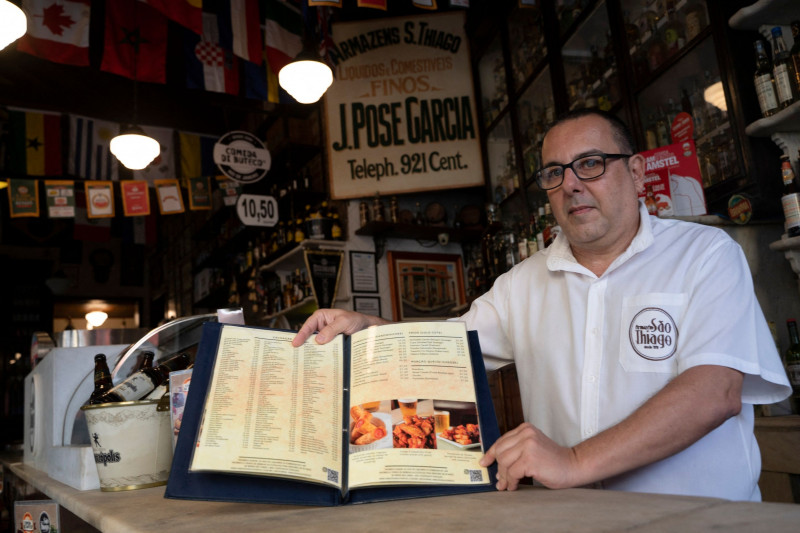
LEAFING through the leather-bound menu at a classic Rio de Janeiro restaurant, the tile-floored, wood-panelled Armazem Sao Thiago, 28-year-old Paula Cardoso says something that amounts to heresy in this establishment: "I prefer QR code menus."
Founded in 1919 and owned by the same family for three generations, Armazem Sao Thiago is a place that frowns on QR codes, those newfangled hieroglyphs that surged during the Covid-19 pandemic, letting contact-wary diners access digital menus on their cell phones.
The bar and restaurant takes pride in its menu, which waiters in impeccably pressed white shirts deferentially hand customers.
"It's the introduction to the house," says Carlos Fionda, 59, a manager at the restaurant – affectionately nicknamed "Bar do Gomes" – in the picturesque hillside neighborhood of Santa Teresa.
"That's how the client's experience starts. You chat with them, help them make the best choice... Not a cold, impersonal thing."
Fionda is not alone in defending the good old-fashioned menu – a subject that stirs passions worldwide.
Rio state adopted a law last week requiring restaurants and bars to offer physical menus for clients who lack smart-phones, have technological troubles or simply want to ignore their devices and enjoy a meal with family and friends.
Several other states are considering similar measures.
And the QR code kerfuffle goes far beyond Brazil.
A comparable bill is in the works in Miami, Florida. Colombia adopted a similar measure last year. Lawmakers in Mendoza province, in Argentine wine country, are meanwhile pushing the other way, with a bill that would require a digital menu option.
It's a touchy topic in a world suddenly dominated by digital dining.
With pandemic-era fears of surface-borne contagion now a receding memory, many diners voice frustration at the lingering omnipresence of digital menus and their drawbacks – the agony of navigating on a tiny screen, the connection problems, the dead phone battery threat, the lack of human contact.
"QR code menus are the death of civilisation," a Washington Post columnist opined last year.
"F*** QR codes. I just want to hold a menu again," railed an article in Vice magazine.
"Can we finally say QR code menus are a gigantic pile of shit?" Brazilian influencer Felipe Neto asked in a Twitter post that went viral in May.
‘Here to stay’
But hold the hostility, please, say the digital menu's defenders.
They are "much more practical," says Cardoso, the trendy young marketing manager who found herself going vintage at Armazem Sao Thiago.
"You can access it on your phone, there are more pictures of the food. You can explore the menu better. (Traditional) menus get old."
Many restaurateurs love the technology – and quietly hope clients will learn to love it, too, saying it facilitates innovation, seasonality and freshness.
"I just added Japanese food to my menu. If I had 50 physical menus, I'd have to change 50 copies. With digital, you can change it in a few minutes, with zero environmental impact," says Andre Delfino, 50, manager of elegant Santa Teresa restaurant Casa Nossa.
The technology "is here to stay," he predicts.
At Cafe do Alto, in a historic building near Santa Teresa's iconic tram-line, co-owner Francisco Dantas calls himself a traditionalist who prefers an intimate, tech-free dining experience.
But he loves his QR code menu when it comes to his constantly evolving selection of craft beers.
"It's super fluid. I can change it on my phone any time. Just go in, control C, control V, add the new ones," says Dantas, 43.
The Brazilian Association of Bars and Restaurants wants the government to leave the decision to owners.
"It's a matter for the market," says spokesman Jose Eduardo Camargo.
"Both systems have their advantages and fans."
The association found in a recent survey that 38 percent of Brazilian restaurants have adopted digital menus; another 25 percent plan to.
That accelerating ubiquity is what worries Rio state lawmaker Rodrigo Amorim, who introduced the new law.
"We're probably heading for a world of all-digital menus. But the change should be respectful and inclusive," he says.
In the meantime, "there's nothing more romantic than arriving in a restaurant, holding a menu in your hands and deciding what to eat," he said. – AFP, June 12, 2023