HONG KONG – Bent over a low bench in his cluttered Hong Kong workshop, dark-framed glasses perched on his nose, Lui Ming deftly assembles a bamboo steamer, a utensil essential to Cantonese cooking.
It's a craft the 93-year-old has been perfecting for seven decades, and steamers like his are an indispensable part of yum cha, the Cantonese brunch involving tea and dim sum – perhaps the most prized culinary ritual in the city.
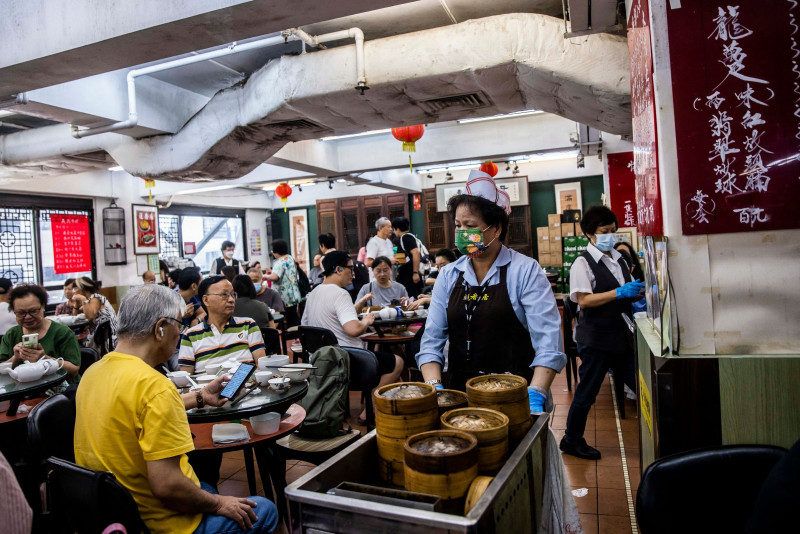
The circular bamboo baskets are ferried in small trolleys around yum cha restaurants, filled with bite-sized dumplings and other delicacies.
"My only hobbies are yum cha and Cantonese opera," Lui tells AFP while twisting thin strips of bamboo to build the single most important dim sum-making tool.
"Those are the joys of my life."
Hong Kong is equally acclaimed for its fine dining restaurants and its street-side eateries, and the enduring use of handwoven steamers in both is part of a set of unique food traditions that have shaped its culinary landscape for generations.
As in many modern metropoles, the flow of commerce in the finance hub brings constant change, but Hong Kong’s cuisine remains wedded to a network of traditions that residents view as staunch markers of local identity.
"Bamboo steamers absorb moisture and there won't be condensation (on the lid)," Lui explains, adding that metal or plastic versions would never pass as part of an authentic yum cha experience in Hong Kong.
But he does add steel around the bamboo rim to make his steamers more durable and improve insulation, an innovation he says he pioneered.
"For steaming buns, there is no substitute."
Hong Kong institutions
Liu's shop is located on Shanghai Street, a historic stretch of road in Hong Kong's Kowloon district that is a treasure trove of kitchenware and utensils.
One block north is Chan Chi Kee cutlery – a family-run Hong Kong institution more than 100 years old.
Retired craftsman Mr Chan, who is part of the clan that runs the shop and now in his 80s, spends much of his time there.
He started forging cleavers when he was around 15 years old as part of the already-established family business.
"I was given a piece of metal and shaped it into a knife," he says, giving only his surname.
"It was on the mountainside in the squatter huts... But eventually there was not enough space – they built housing there."
Today, Chinese chefs from around the world visit Chan Chi Kee's storefront on Shanghai Street to buy handcrafted cleavers and woks.
"At least 80% of Chinese restaurants in Hong Kong use our knives," Chan tells AFP.
But rising property prices and the city's shift away from manufacturing has pushed the bulk of production for the knives, woks and steamers to Guangzhou, China – though a small select stock is still 'Made in Hong Kong'.
Increased wages have also contributed to soaring costs, says Wong Yan-wai, a dried seafood trader for over three decades.
"Most dried seafood is not processed in Hong Kong because of the high cost," Wong, 53, tells AFP.
The fresh seafood is caught across the world and dried on-site – in South Africa, Japan, Brazil and Australia – before being shipped to Wong's shop on Des Voeux Road.
More colloquially known as 'Dried Seafood Street', it and its neighbouring side streets are home to nearly 200 vendors hawking dried scallops, bird's nest, abalone, sea cucumber and more.
Pulling out a dried fish bladder from an ornate gold box, Wong says it is priced at 168,000 Hong Kong dollars (US$21,500) due to its age and size.
"For businesses that do well, they can make 800 million to a billion Hong Kong dollars a year in revenue."
'Modernise Cantonese food'
Ten minutes away, ArChan Chan deftly flips dried shrimp in a carbon steel Chan Chi Kee wok to make her version of the classic Cantonese dish known as stir-fry king.
The 37-year-old chef at Ho Lee Fook, located in the glitzy Central district, is one of the city's most celebrated women chefs and among a handful of young innovators redefining Cantonese food.
"One of the biggest challenges I have is how to modernise Cantonese food," ArChan says.
The answer lies in sourcing quality ingredients while making small tweaks to dishes' flavour profiles, such as adding fermented aged garlic soy to a classic razor clam dish.
In her sleek kitchen, Archan lifts the lid of a bamboo steamer to unveil three glistening vegetable dumplings, ready to be served.
"There is such a big wealth of knowledge," she tells AFP. "I want to be able to learn and absorb as much as possible and just to pass it on." – AFP, June 14, 2023