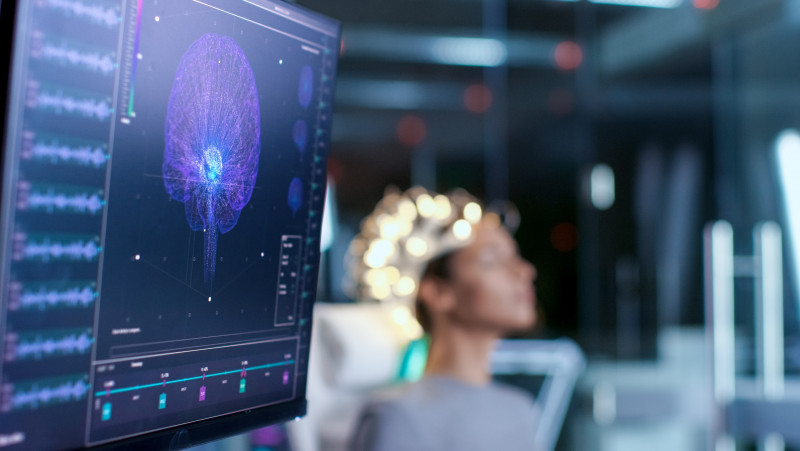
BRAIN implants have long been trapped in the realm of science fiction, but a steady trickle of medical trials suggests the tiny devices could play a big part in humanity's future.
Billions of dollars are flowing into a clutch of specialist companies hunting for treatments for some of the most debilitating ailments.
And pioneering studies have already yielded results.
In May, a Dutchman paralysed in a motorcycle accident regained the ability to walk thanks to implants that restored communication between his brain and spinal cord.
That experiment was one of several eye-catching trials that have helped spark a huge buzz around the industry.
In the decade to 2020, investors poured more than US$30 billion (RM139.47 billion) into neurotechnology more widely, according to Unesco.
And the money has continued to flood in thanks, in part, to rapid improvements in artificial intelligence (AI), used by researchers to interpret the data from the implants.
Tech titan Elon Musk has refocused some energy on his Neuralink firm after it received permission in May to test its implants on humans, helping it to raise US$280 million in funding.
And other firms with less prominent bosses are proliferating, offering hope for sufferers of ailments from rare nerve diseases to severe epilepsy.
‘Turning point’
Synchron, a company formed more than a decade ago, raised US$75 million this year with backing from the likes of Microsoft co-founder Bill Gates and Amazon's Jeff Bezos.
The firm got permission from the US authorities in 2021 to test its implant, and has since rolled it out to nine people with Amyotrophic Lateral Sclerosis (ALS) – the motor neurone disease that physicist Stephen Hawking suffered from.
Its implant allows patients to use messaging apps or browse online using only eye movements and thoughts.
One of the big selling points is that, unlike other implants, it does not require invasive surgery.
The first goals of the Synchron test, said Dr David Putrino, who oversaw the medical trial at Mount Sinai Hospital in New York, were to make sure the implant was safe and could monitor the brain over long periods.
On both fronts, he said, the trial had been a success.
Synchron founder Tom Oxley thinks the technology, known as brain-computer interface (BCI), is now at a "turning point".
The industry must aim to make the implants widely accessible, he told AFP.
Brain attack
There are still pretty hefty impediments before that can happen, not least that the most powerful results often come from the most invasive implants.
For example, a patient in the US, Ian Burkhart, who was left paralysed from the neck down after a diving accident, told AFP that getting an implant that allowed him to control his arms and hands again was a "magical moment".
But he was only ever able to do that in a lab and the implant, known as a Utah array, was far from comfortable.
"The brain doesn't like having stuff inside it," said Michael Platt, professor of neuroscience at the University of Pennsylvania.
"And so the immune system of the brain will attack these devices," he said of the Utah arrays.
As the implants get covered by cells, they are less able to transmit signals from the brain and they function less well.
Although far less advanced, some researchers are pinning their hopes on techniques that do not involve implants.
In May, scientists at the University of Texas at Austin said they had used brain scans and AI modelling to glean "the gist" of what people were thinking.
The technique relied heavily on the GPT models developed by OpenAI, which are capable of analysing massive chunks of data increasingly quickly.
But such research is at the very earliest stage and involves patients spending as much as 16 hours each time in an MRI scanner.
Musk’s telepathy plan
While most players in the field are exclusively concerned with medical uses for neurotechnology, Musk is different.
The maverick tycoon is touting the possibility of telepathy, using the technology to store memories or to enable humans to continue their existence without their bodies.
"In the future you will be able to save and replay memories," he told a Neuralink event in 2020.
"You could potentially download them into a new body or into a robot body."
These claims remain far from reality but this has not stopped Musk from going even further.
He sees implants as a way of enhancing humans -- a vital move, he thinks, if our species is to co-exist with superintelligent machines.
"That might be the most important thing that a device like this achieves," he said. – AFP, August 22, 2023