AWARENESS of the Malaysia Agreement 1963 (MA63) has reached new heights in Sabah.
Increasingly, locals are discussing pivotal issues such as the 40% revenue entitlement, which is also being adjudicated in court.
However, political divisions among state party leaders are now becoming a significant hurdle to the struggle to restore and implement the state’s rights.
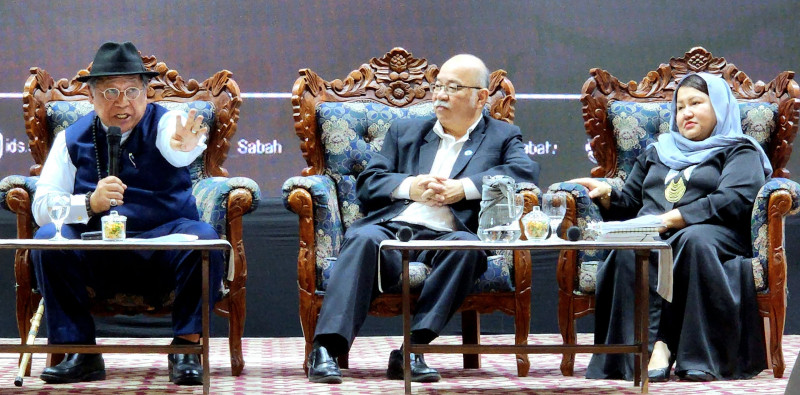
A forum held yesterday, organised by the Sabah think tank Institute Development of Studies, featured senior politicians and a lawyer as panelists. They unanimously acknowledged the widespread awareness of MA63.
But they also said that state political leaders across the spectrum leveraging on the treaty are creating political divides.
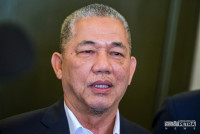
Former Dewan Rakyat speaker Tan Sri Pandikar Amin Mulia, one of the panelists, cited the egos of state party leaders as the reason for political disunity in Sabah when it comes to MA63.
He contrasted this with Sarawak, which has made more substantial progress on MA63 issues due to its political unity.
“When you are united, there’s no room for others to divide and rule,” said Pandikar while asserting that political will was key to resolving the state rights issue.
Speaking at the “Malaysia Agreement Forum: Implications for the Sabah Region”, Pandikar said that Sabah’s political history demonstrates the state’s ability to overcome challenges when political egos are set aside to achieve common goals in the past.
For example, despite political differences, Sabahans were able to unite for the common interest of forming Malaysia in 1963, partly due to external pressures from the Philippines and Indonesia’s claims over Sabah.
As such, Pandikar said he believed MA63 can be used as the tool to unite the political fronts in Sabah again.
Lawyer Mazlianie Mohd Lan observed that more people are discussing MA63 openly as political leaders have embraced the issue today.
This was a far cry from the situation many Sabahans have experienced when MA63 was a taboo topic, she said.
Mazlianie, who co-wrote the children’s book “My Country and I: The Malaysia Agreement 1963”, said she does not blame state political leaders for the delay in realising the terms of MA63.
She said many leaders were afraid to talk about MA63 for fear they might get arrested under the Internal Security Act (ISA).
Sabah Deputy Chief Minister Datuk Seri Jeffrey Kitingan was incarcerated for two-and-a-half years from 1991.
“This is why they could not voice out previously. In the past, some were detained under ISA when they talked about state rights,” she said.
Mazlianie also noted the lack of detailed understanding of MA63 due to limited information available at the time.
Meanwhile, former Sabah chief minister Datuk Seri Yong Teck Lee noted renewed efforts to restore Sabah’s lost rights due to the rising awareness among the masses which happened through decades of political process.
He dismissed the idea that the deterioration of Sabah’s rights had happened covertly.
“We cannot talk about now like we are still in the ’60s or the ’80s. There’s already significant political climate change,” he said.
Yong attributed these changes to three factors: the internet providing freer access to information, growing awareness and education among the younger generations, and the abolishment of the ISA.
The ISA was abolished on September 15, 2011.
The deterioration of Sabah’s rights guaranteed by MA63 has been a contentious issue, with many arguing that it occurred through both formal processes and covert actions.
The amending of Article 1(2) of the Federal Constitution in 1976 to downgrade Sabah and Sarawak from territories of equal status to mere states had been one of those key formal processes.
Meanwhile, the implementation of federal policies often sidelined Sabah’s interests, gradually eroding the state’s autonomy, and the detention of MA63 proponents in 1991 have been termed as covert actions to suppress the state’s rights.
Also present at the forum were IDS chairman Datuk Azizah Mohd Dun; IDS CEO Datuk Ramzah Dambul; former Sabah attorney-general Datuk Mariati Robert, who also the moderator of the forum; Sabah attorney-general Datuk Brendon Soh; and former Sabah Law Society president Datuk Roger Chin. – August 4, 2024