AN advocacy group’s proposal for 15 more Senate seats each to Sabah and Sarawak to block unilateral constitutional amendments by Peninsular Malaysia should be rejected, a political analyst said.
James Chin, an Asian Studies professor at the University of Tasmania, said Projek Sama’s Dewan Negara proposal is a "trick to maintain the status quo."
"This proposition is yet more evidence of Malaya-based organisations' failure to understand the historical grievances of the Borneo states and their claim to one-third of seats in both houses of parliament," he said in a statement today.
Chin gave six reasons for why the proposal should be rejected.
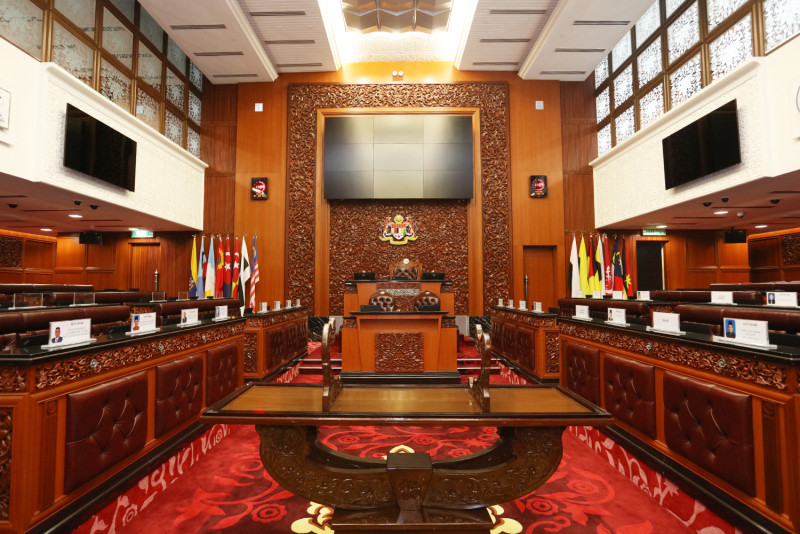
The first is that the Dewan Negara lacks political legitimacy in Malaysian politics, as it is a fully appointed house.
"Its members are not directly elected by the public. This is why, for many years, debates in the Dewan Negara have garnered far less attention than those in the Dewan Rakyat."
Chin added that many Dewan Negara appointees are perceived as being rewarded with a seat for their service.
"This is why the Dewan Negara has a significant number of retired politicians."
The second reason, Chin said, is that all major legislation is introduced in the Dewan Rakyat, where "the actual discussion takes place."
"The Dewan Negara only debates laws passed by the Dewan Rakyat and, therefore, lacks the legislative authority to block significant bills."
Thirdly, Chin said the country’s top leadership were all in the Dewan Rakyat.
He said ministers from the Dewan Negara are often regarded as "backdoor ministers" because they had to be appointed to the Senate first.
"This alone shows that the political establishment views the Dewan Rakyat as more important than the Dewan Negara."
Chin's fifth reason is that, in practice, the Dewan Negara has no real power to block laws and can only delay them.
"The one-third seats in the Dewan Rakyat are designed to restore Sabah and Sarawak’s ability to block constitutional amendments if they disagree with Malaya."
Finally, Chin said, the Federal Constitution was written to give Singapore, North Borneo, and Sarawak a veto over Malaya.
He referred to Chapter 3, paragraph 9 of the Malaysia Agreement 1963 (MA63), which states: "The House of Representatives shall consist of one hundred and fifty-nine (159) elected members, and there shall be one hundred and four (104) from the states of Malaya, sixteen (16) from Sabah, twenty-four (24) from Sarawak, and fifteen (15) from Singapore."
Chin cited paragraph 19 of the Inter-Governmental Committee (IGC) Report and Article 46 (1) of the Federal Constitution, which made clear that Singapore, North Borneo (now Sabah), and Sarawak did not want Malaya to dominate parliament when it came to constitutional amendments.
He said the IGC report and Article 46 (1) ensured that Singapore, Sabah, and Sarawak would hold veto power by controlling slightly more than one-third of the seats in parliament.
When Singapore left the Federation in 1965, its 15 parliamentary seats were not redistributed to Sarawak or Sabah, which Chin described as a "historical error that needs to be rectified."
"Over time, Malaya's parliamentary seats have grown to more than two-thirds of the total seats in the Malaysian parliament."
"I hope the people of Sabah and Sarawak understand the proper context behind the call for one-third of the seats in parliament and are not misled by NGOs in Malaya who have their own agenda."
Currently, Sabah and Sarawak hold 7.1% of the seats in the Senate.
Projek Sama has argued that its proposal, dubbed Dewan Negara 35/100, would give Sabah and Sarawak 35% of Senate seats, ensuring the Borneo states have a stronger voice in the legislative process.
The advocacy group said it is more feasible to reform the Dewan Negara than it is to do the same for the Dewan Rakyat, where more seats for both Sabah, Sarawak, and Peninsular Malaysia could lead to a bloated parliament. – September 16, 2024.