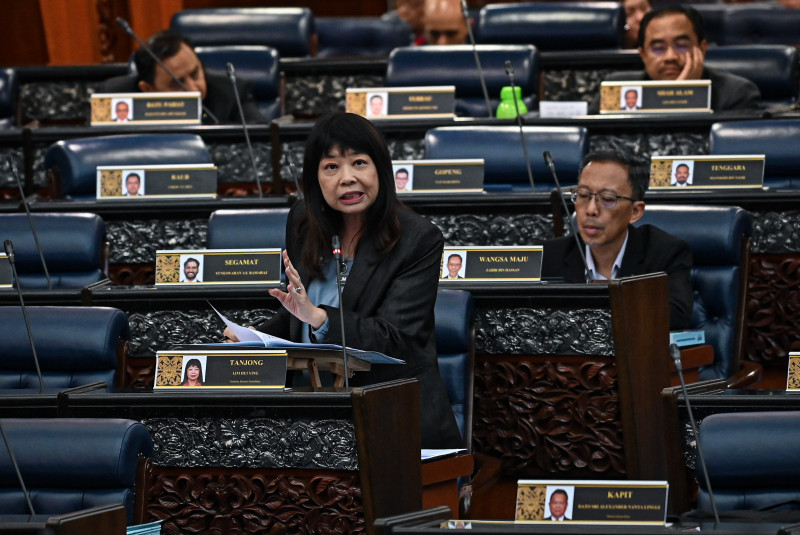
THE government is intensifying efforts to strengthen fiscal discipline and improve credit regulation to address growing public debt and consumer financial vulnerabilities, Deputy Finance Minister Lim Hui Ying said during a parliamentary session on Tuesday.
Responding to questions from Datuk Ngeh Koo Ham (Beruas) and Datuk Indera Mohd Shahar Abdullah (Paya Besar), Lim said the government is committed to reducing debt accumulation while maintaining economic growth and safeguarding household financial health.
Gross federal borrowings for 2024 totalled RM197.5 billion, a decrease from RM226.6 billion in 2023. This reduction aligns with Malaysia’s fiscal consolidation agenda, which has seen the national deficit narrow from 5.5% of GDP in 2022 to 4.1% in 2024, with further contraction projected to 3.8% in 2025.
"The government remains committed to ensuring that the fiscal deficit remains below 3% of GDP and the debt-to-GDP ratio does not exceed 60% in the medium term, as outlined in the Public Finance and Fiscal Responsibility Act (Act 850)," Lim told lawmakers n the Dewan Rakyat today.
As of June 2025, federal government debt stood at RM1.3 trillion, compared with RM1.25 trillion at the end of 2024. The increase, Lim noted, was due to necessary funding for development expenditure, while federal liabilities fell slightly to RM384.6 billion as of March 2025, down from RM384.8 billion at the close of 2024.
She stressed that borrowings are managed prudently and directed towards strategic development projects in infrastructure, education, healthcare, and social safety nets, which offer long-term national returns.
The government is also working to broaden the national revenue base, rationalise subsidies and public spending, enforce stricter borrowing limits, and promote public-private partnerships through the Public-Private Cooperation Master Plan 2030 (PIKAS 2030).
In addition, off-budget project financing will be limited to those covered under the Five-Year Malaysia Plan to ensure fiscal transparency and discipline.
Complementing these efforts are major economic transformation plans, including the National Energy Transition Roadmap (NETR), the New Industrial Master Plan 2030 (NIMP 2030), and the GEAR-uP initiative to reform government-linked companies.
These policies are intended to spur growth, boost revenue, and reduce long-term reliance on borrowing.
Lim also addressed concerns about consumer credit, stating that the government is enhancing regulatory oversight of credit services to protect consumers from unsustainable debt levels.
“Various policies have been introduced to ensure responsible borrowing through credit services, which is crucial to mitigate debt risk and protect consumer resilience and the country’s financial stability,” she said.
Bank Negara Malaysia’s Responsible Financing policy, implemented since 2012, continues to govern the lending practices of financial institutions. Under this framework, the household debt service ratio (DSR) remains within prudent limits, with a median DSR of 34% for total loans and 41% for new loans as of 2024.
Recognising the rapid rise of Buy Now Pay Later (BNPL) schemes, Lim noted that the Dewan Rakyat passed the Consumer Credit Act (RUUKP) on 21 July 2025. The new law introduces comprehensive oversight of non-bank credit providers and digital credit platforms, many of which were previously unregulated.
To assist borrowers facing financial distress, the government continues to support the Credit Counselling and Debt Management Agency (AKPK), which has helped over 64,000 individuals fully settle their debts and is currently assisting nearly 270,000 active clients through financial recovery programmes.
Lim added that improving financial literacy is also a government priority. The Financial Education Network (FEN), a national initiative, aims to increase public awareness of prudent financial management to prevent Malaysians from falling into debt traps. - July 29, 2025