MINISTER of Investment, Trade and Industry Tengku Zafrul Adbul Aziz has called on ASEAN to respond to mounting global fragmentation by doubling down on economic reform, regional cohesion and international diplomacy.
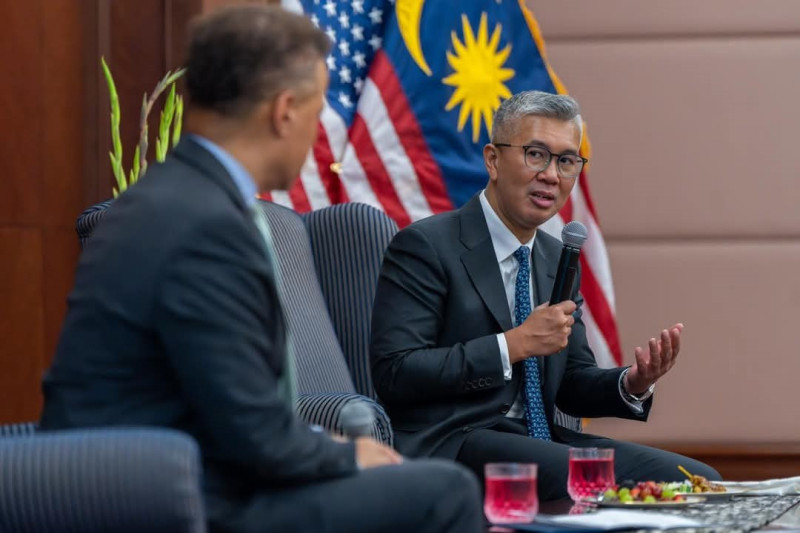
Delivering the keynote address at PRAXIS 2025, themed ‘From Fracture to Future,, Tengku Zafrul noted that disruption is now a defining feature of the global order. “From rising tariffs and tech controls to fractured international cooperation, we are witnessing a fundamental reshaping of the global economy,” he said.
He argued that ASEAN must “turn geography into strategy, neutrality into strength, and openness into opportunity,” warning that the pace of change is accelerating, and the region must adapt or risk marginalisation.
Reflecting on Malaysia’s role as ASEAN Chair, Tengku Zafrul highlighted several achievements in regional trade, including concluded negotiations on upgrades to the ASEAN Trade in Goods Agreement and the ASEAN-China Free Trade Area. These modernised agreements, expected to be signed in October, expand beyond goods to include services, e-commerce and support for SMEs.
Malaysia has also tabled the ASEAN Framework on Integrated Semiconductor Supply Chain (AFISS), which aims to establish Southeast Asia as a unified base for chip design, manufacturing and distribution. “ASEAN member states must collaborate, not compete, in attracting foreign direct investment,” he said.
The minister pointed to the upcoming ASEAN Digital Economy Framework Agreement (DEFA) as another milestone, necessary for governing cross-border data flows, paperless trading and cybersecurity in what is projected to become a USD2 trillion digital economy by 2030.
Tengku Zafrul also underlined the need for diversification, citing the ASEAN-GCC-China Summit and its potential to spark a future ASEAN-GCC Free Trade Agreement. Sectors such as renewable energy, halal trade and Islamic finance were identified as key areas of growth.
On Malaysia’s own position, the minister reaffirmed the country’s long-standing commitment to open, rules-based trade and a foreign policy grounded in strategic non-alignment. Referencing Malaysia’s recent engagement with BRICS, he said: “Our engagement with BRICS is forward-looking rather than ideological. Neutrality is about friendship with all, not choosing sides.”
He cited deepening bilateral ties with India and Brazil, particularly in semiconductors and industrial cooperation, as evidence of Malaysia’s commitment to building partnerships across the Global South.
At the domestic level, Tengku Zafrul reiterated the importance of structural reform. He pointed to the New Industrial Master Plan (NIMP2030) and the 13th Malaysia Plan as key to unlocking inclusive growth, innovation and resilience.
He added that these reforms would strengthen Malaysia’s credibility in regional policy leadership.
He also addressed Malaysia’s role in ASEAN’s collective response to the “Liberation Day” tariffs, emphasising that the bloc chose dialogue over retaliation.
“ASEAN prioritised negotiation over confrontation,” he said, insisting this demonstrated the enduring strength of the ASEAN Way.
However, he cautioned that ASEAN must not become complacent. “Reform must become part of the ASEAN Way,” he said, calling for member states to engage in more candid discussions on economic models and structural transformation.
Tengku Zafrul invoked the words of Malaysia’s founding Prime Minister, Tunku Abdul Rahman: “The key to progress and prosperity doesn’t rely on contentment with what has been achieved, but on the steadfast resolve to strive for more in the days ahead.”
He closed with a rallying call: “From fractured supply chains, we will build resilient ecosystems. From economic uncertainty, we will craft enduring partnerships. Let us not speak of fracture as an end — but as a beginning.” - August 7, 2025