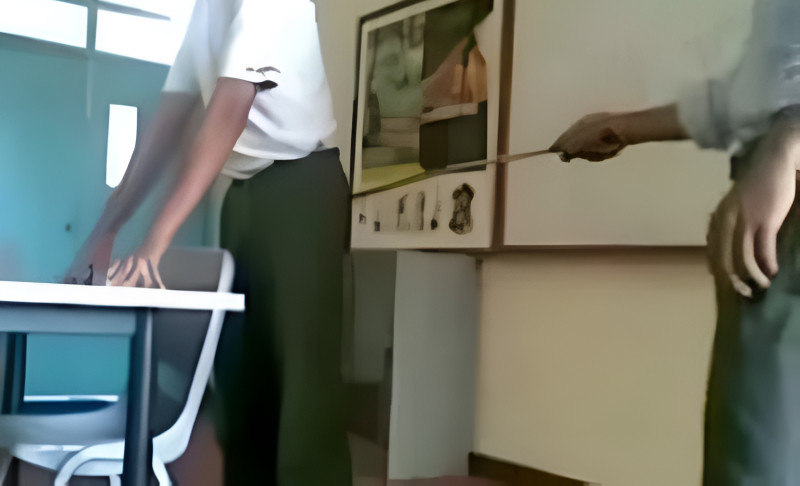
PARENTS and school leaders have voiced strong support for the reintroduction of caning as a disciplinary measure in Malaysian schools, provided it is implemented under strict guidelines and does not compromise student health or safety.
Noor Azli Khamis, a father of two primary school children, said that today’s education system is facing “serious challenges” in managing student behaviour.
“From truancy to disrespect towards teachers and even bullying, the situation is deteriorating. In this context, caning can serve as a symbolic reminder that every action has consequences,” he told Sinar Harian.
“Not all students respond to words alone. Some need a firmer approach to realise their actions have limits,” he added.
His comments follow recent remarks in Parliament by Hulu Terengganu MP Datuk Rosol Wahid, who called for caning to be reinstated for students with persistent disciplinary issues.
“In our time, caning was part of school life. But today, the ministry seems to place more weight on parental opinion,” Rosol had said in the Dewan Rakyat.
Noor Azli stressed that caning should never be used arbitrarily, and that the Ministry of Education must introduce clear policies to prevent abuse and protect students from harm.
“There must be clear rules, such as allowing only certain teachers — like discipline teachers, principals or headmasters — to administer caning. It should only be done on specific areas like the palm or buttocks, never on the face or sensitive parts,” he said.
He added that the number of strokes should be limited and each incident recorded in a discipline log to ensure transparency and accountability.
“With proper control, caning can be an effective tool. But without rules, problems will arise because not every teacher can manage their emotions when dealing with difficult students,” he said.
Siti Fatimah Lawang, a private-sector employee and mother of three, also supported the idea, viewing caning not merely as physical punishment but as a form of educational discipline.
“It helps teachers maintain control, especially when facing stubborn students who refuse to change despite repeated warnings,” she said.
“Caning sends a clear message to all students that the school is serious about discipline. My experience raising children has taught me that not all kids respond to gentle approaches. Some need firmer reminders to understand consequences,” she added.
Haidzir Sham Masngat, President of the Parent-Teacher Association (PIBG) at SK Seksyen 20, also expressed agreement — on the condition that any form of corporal punishment be conducted according to clear and ethical principles.
He outlined key factors for proper implementation: parental awareness, an educative purpose behind the punishment, and the suitability of the child’s age and physical condition.
“Before caning is carried out, the school must inform parents about the child’s misconduct. And it should only be used if it truly imparts awareness and remorse,” he said.
He cautioned against applying the punishment to young or physically vulnerable pupils and stressed that caning must never be used to humiliate.
“The aim is character-building, not punishment for punishment’s sake. It should be a last resort after counselling and moral guidance have been tried.”
“In some cases, a firmer approach may be necessary — but it should never be executed lightly. If the punishment is too mild, it won’t serve its purpose,” he said.
At the secondary school level, Norliza Sahib, President of the PIBG at SMK Shah Alam, gave her full support for the return of caning.
“Caning is not just punishment, but a form of teaching, awareness, and shaping a disciplined character so students don’t repeat mistakes,” she said.
“It is part of the educational process, especially for students who are persistently indisciplined. But it must be done according to proper procedures and in a manner that is appropriate.” - Sept 3, 2025