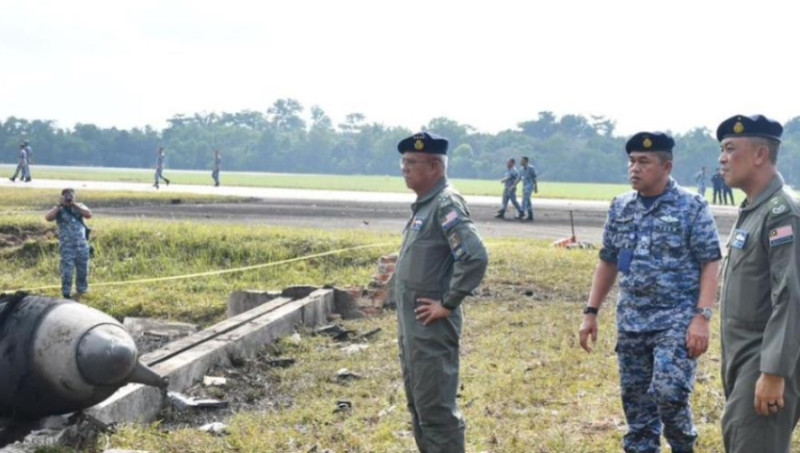
A ROYAL Malaysian Air Force (RMAF) F/A-18D Hornet crash in August was caused by a birdstrike, according to the preliminary findings of an official investigation.
RMAF Chief General Datuk Seri Muhamad Norazlan Aris confirmed today that the incident, which occurred on 21 August, resulted from a large bird being ingested into the aircraft’s left engine during take-off, causing a complete loss of thrust and forcing the pilot to eject.
“The aircraft’s left engine failed when a large bird was sucked in during the take-off phase,” said Norazlan during a press conference on the board of inquiry’s early findings.
He added that the investigation had been ongoing since 22 August and was supported by multiple agencies, including the Defence Science and Technology Research Institute, the Department of Chemistry, the Royal Malaysian Police, the Department of Wildlife and National Parks, and the United States Navy.
“The investigation was supported by CCTV analysis, data from the Deployable Flight Incident Recorder System, technical assessments and reports from the agencies involved,” he said.
While bird strikes are common in aviation, Norazlan noted that this marked the first time such an event had led to the loss of an RMAF fighter aircraft.
“It depends on the type of bird, its size and the phase of flight. The most critical points are take-off and landing, when the aircraft is at low altitude and relatively low speed. Any disruption to aerodynamics or engine thrust at that stage can cause the aircraft to fail to remain airborne.”
The bird responsible was identified as a purple heron, a large wading species that can weigh up to 1.5 kilograms. The impact caused catastrophic damage to the engine’s internal blades.
“The aircraft had rotated for take-off at around 152 knots, just after passing V1 speed at 146 knots. At that point, you cannot abort,” said Norazlan.
“Unfortunately, the engine lost thrust almost immediately, at about 30 feet altitude. The pilot had no option but to eject to save himself.”
The incident prompted a temporary grounding of RMAF Hornet operations, pending safety assessments and inspections. - September 18, 2025