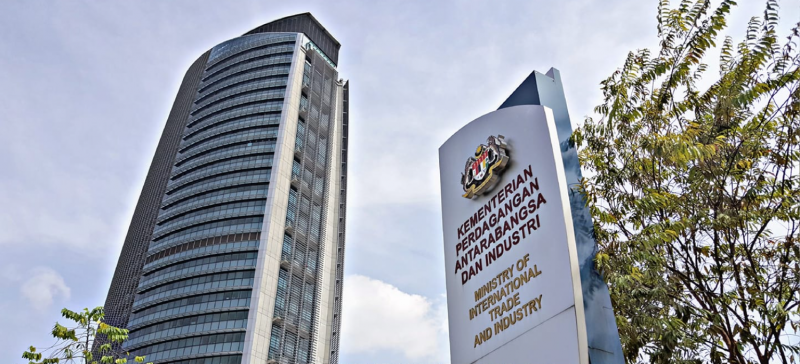
THE Ministry of Investment, Trade and Industry (MITI) has reiterated that Malaysia’s sovereignty, policy autonomy and national interests are fully safeguarded under the Malaysia–United States Agreement on Reciprocal Trade (ART).
The Ministry, in a statement on Monday, described the ART not as a conventional free trade agreement initiated by Malaysia, but as a measured response designed to defend national interests, protect jobs and preserve Malaysia’s export markets in the face of unilateral U.S. tariffs imposed on multiple trading partners.
MITI stressed that no amendments to Malaysian law were required as a precondition to signing the agreement, affirming that Malaysia retained full control over the negotiation process.
The Government also undertook a thorough due process, engaging all relevant ministries and agencies to assess the legal, economic, security and sectoral implications of the ART.
Scenario analyses indicated that failure to engage would likely have resulted in substantially higher tariffs, wider product coverage, and greater uncertainty for exporters, investors and workers.
MITI emphasised the urgency of securing Malaysia’s top export market, adding that the ART was not a free trade agreement and that prompt action was essential.
“The ART is not a free trade agreement, and the sense of urgency was crucial to help continue securing Malaysia’s top export market,” MITI stated.
The Ministry outlined extensive consultation prior to signing, including ten engagement sessions with Parliament, the Backbenchers Club, the Opposition Bloc and the Special Select Committee on International Relations and International Trade.
Engagements with relevant ministries covered tariff, fiscal, diplomatic, food security, health, agriculture, plantation industries and commodities matters.
Agencies consulted included the Attorney-General’s Chambers, Bank Negara Malaysia, JAKIM, Department of Veterinary Services, National Pharmaceutical Regulatory Agency, Medical Device Agency, and the Royal Malaysian Customs Department.
MITI highlighted the economic stakes: in 2024, Malaysia–U.S. trade totalled RM325 billion, with exports accounting for RM198.65 billion.
From January to September 2025, exports to the U.S. reached RM166.38 billion, cementing the United States as Malaysia’s largest export market.
Without the ART, exports could have faced tariffs of 24 to 25 per cent or higher, threatening key sectors such as semiconductors, pharmaceuticals, E&E, aerospace, rubber and cocoa, and placing the livelihoods of millions of Malaysians at risk.
“An adverse outcome would have jeopardised thousands of businesses and the livelihoods of millions of Malaysians across key sectors including E&E, aerospace, rubber, cocoa and pharmaceuticals,” MITI noted.
The ART achieved concrete outcomes for Malaysia, including a reduction in the reciprocal tariff rate from 25 per cent to 19 per cent—the lowest applied to most ASEAN countries with a trade surplus with the United States.
The agreement secured exemptions for 1,711 tariff lines, protecting approximately RM22 billion in exports covering palm oil, rubber, cocoa, aerospace parts and pharmaceuticals, with potential for further growth.
Malaysia maintained import duties averaging 7 per cent on U.S. goods and preserved protections for sensitive sectors.
MITI emphasised that key red lines, including Bumiputera policies, government procurement and strategic sector ownership in energy and telecommunications, were fully upheld.
“No clause in the ART overrides these red lines,” the Ministry stated. Provisions such as Articles 5.1 and 5.2 are anchored in Malaysian domestic law, while Articles 3.3 and 5.3 require consultations with the United States but do not confer any veto over Malaysia’s trade policy.
The ART has supported 1.1 million jobs and provided opportunities to at least 7,000 SMEs, offering certainty to investors and the export sector.
For the period January to September 2025, steady exports and approved investments contributed to Malaysia’s 5.2 per cent GDP growth in the third quarter. “The ART therefore functions as a defensive, stabilising instrument.
“It mitigates the risk of sudden tariff shocks, secures better treatment than many peers facing the same U.S. unilateral measures, and sends a clear signal that Malaysia is committed to protecting critical export markets while upholding its sovereign right to regulate in the national interest,” MITI said.
The Ministry reaffirmed its commitment to transparent, fact-based discussions on ART, promising to continue briefing Parliament and stakeholders so the public can evaluate the agreement based on accurate information.
“Implementation of the ART will remain firmly grounded in Malaysia’s laws, national interest and independent foreign policy,” it added. - November 17, 2025