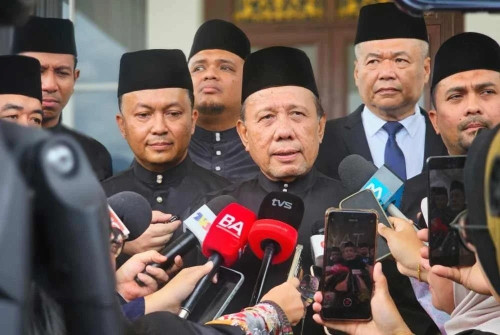
PUBLIC trust in traditional media remains strong in Malaysia despite the dominance of social media as the primary source of breaking information, according to a recent study by the Malaysian Communications and Multimedia Commission.
Communications Minister Datuk Fahmi Fadzil said the findings highlight a striking contradiction in modern media consumption, particularly among younger Malaysians aged between 18 and 35.
The study found that between 87 and 90 per cent of respondents in this age group first receive news updates via platforms such as WhatsApp, followed by TikTok and Facebook.
"However, the level of trust in information from these platforms is low, at only around 40 to 50 per cent... in contrast to television, radio and newspapers, which they rarely consume but, when they do read, hear or watch something, the level of trust is very high," he said.
Fahmi made the remarks during an appearance on a broadcast programme produced by Radio Televisyen Malaysia, where he discussed the evolving credibility of media in the digital era.
He said the findings underscore a paradox in today’s information landscape, where access to news is faster and more widespread than ever through smartphones, yet credibility remains anchored in conventional outlets.
The minister noted that media organisations are facing increasingly complex challenges as news cycles accelerate and audience expectations shift.
"If in the past, people waited for specific times such as the 8pm main bulletin to get the news, now there are news flashes and information can be disseminated at any time instantly," he said.
He added that the rise of viral content has intensified pressure on media institutions to balance speed with accuracy.
"The concept of virality is one of the most feared by the media... if the viral content is positive, it is not a problem, but if otherwise, it can have adverse effects on society," he said.
In this environment, Fahmi stressed that adherence to journalistic ethics remains the key distinction between professional media organisations and user-generated content.
"In a situation of information overload and the emergence of technologies such as artificial intelligence, journalistic ethics must continue to be the core to ensure that the information delivered is authentic and trustworthy," he said.
Looking ahead, he suggested that society is still in the early stages of adapting to artificial intelligence, but anticipated a gradual shift back towards more authentic, human-centred content.
Meanwhile, Director-General of Broadcasting Ashwad Ismail said media organisations must refine their strategies in an algorithm-driven landscape by producing more specialised, niche content tailored to audience interests.
He also highlighted the need for appropriate regulation of artificial intelligence to prevent misuse.
"In an era of increasingly advanced technology, humans must continue to be empowered because whether technology is good or bad depends on the individual who uses it," he said. - March 31, 2026