By Murray Hunter
MALAYSIA’S official economic narrative is one of resilience and progress.
GDP growth figures are regularly bandied about, household debt is cited at around 84% of GDP, and poverty statistics are presented as under control.
Yet beneath these numbers lies a festering crisis that official data deliberately or negligently ignores.
That is the widespread reliance on Ah Long or illegal loan sharks, who thrive on the desperation of ordinary Malaysians.
These operators are not a fringe nuisance. They are a symptom of systemic failure in the formal financial system, the absence of a meaningful social safety net, and the rigidity of banks that are, ironically, largely government-owned or controlled.
Most people who turn to Ah Longs are not chasing luxuries or holidays.
They borrow to cover living expenses, medical bills, school fees, vehicle repayments, or to keep micro-enterprises afloat after a drop in income or a spell of unemployment.
When formal banks reject them for lack of collateral, imperfect credit histories, or insufficient documentation, the informal lenders step in with quick cash at ruinous rates, which are often 20–50% per month or higher.
The debt compounds rapidly. Missed payments bring harassment, paint-splashing, public shaming, staged “funerals,” and worse.
Police statistics record thousands of cases and tens of millions in reported losses annually, yet these figures capture only the tip of the iceberg.
Many victims never report for fear of further intimidation or the stigma of having dealt with illegal lenders.
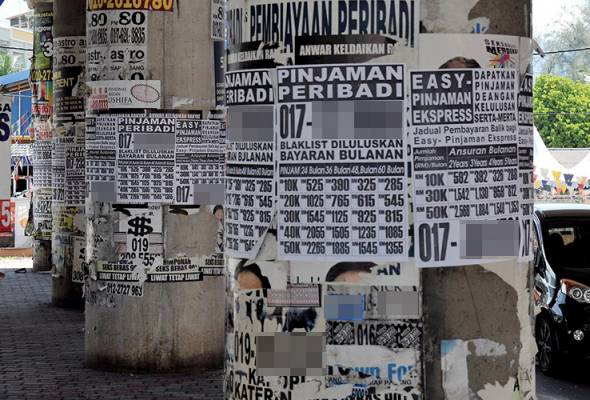
The scale of the problem is inseparable from Malaysia’s large informal economy. Estimates of the shadow or informal sector range widely, but employment data and independent analyses consistently show that a substantial portion of economic activity and the livelihoods of millions operate outside formal financial channels.
Household debt statistics published by the authorities measure only formal obligations to banks and licensed institutions.
They exclude the vast, unmeasured debt owed to Ah Longs.
Adding this hidden burden would push the true indebtedness of Malaysian households far higher and reveal a more precarious financial position than the celebrated figures suggest.
Government-linked banks and financial institutions have long prioritised collateral, credit scores, and formal documentation over need.
This approach is commercially rational for the institutions, yet socially destructive.
It leaves the B40 and lower M40, who are the most vulnerable to income shocks, with few legitimate options.
Microfinance schemes and specialised institutions exist on paper, but coverage remains inadequate, eligibility criteria are often still too stringent, and outreach fails to reach many in genuine distress.
The result is a vacuum filled by unlicensed lenders who operate with near-impunity. Enforcement actions occur, raids are conducted, and runners are sometimes arrested, yet the masterminds and the underlying demand persist.
Reports of off-duty or part-time police involvement in collections, or of information from police reports leaking back to the syndicates, only deepen public distrust.
This is not merely a law-and-order issue. It is an economic and social one that actively deepens poverty.
Families trapped in high-interest cycles lose assets, face mental health crises, and see intergenerational mobility blocked.
Children drop out of education; micro-businesses collapse; households that were already living paycheque to paycheque slide further into precarity.
Spectacular aggregate growth figures mask this reality of hidden poverty and rising vulnerability.
Analysts who focus solely on official metrics miss the quiet transfer of wealth from the desperate to criminal networks and the erosion of social cohesion that follows.
Practical solutions are available if the political will exists.
Expanding genuine microfinance and community-based savings institutions that understand informal and micro-enterprise realities would provide alternatives at reasonable cost.
Government-linked banks, as major players in the system, could be directed to exercise greater latitude in refinancing existing loans and extending credit to those with irregular but viable income streams, without abandoning prudent risk management.
Stronger, targeted social safety nets that respond quickly to unemployment or income shocks would reduce the desperation that drives people to Ah Longs in the first place.
A more effective and properly enforced minimum wage, combined with measures that lift real incomes rather than merely adjusting the statutory floor, would strengthen household resilience over time.
Ultimately, the Ah Long phenomenon is a mirror held up to Malaysia’s development model.
Rigid formal institutions, weak safety nets, and an underserved informal sector create the conditions in which predatory lending flourishes.
Until policymakers confront the gap between official statistics and lived experience, and until the banking system is made to serve the needs of those at the bottom rather than only those who already fit the formal template, loan sharks will continue to extract a heavy human and economic toll.
The problem is not new, but the scale of hidden poverty it reveals can no longer be ignored. – September 5, 2026