By Murray Hunter
TUITION centres have long filled a critical gap in Malaysia’s education system.
Parents, particularly those whose children struggle in national schools or seek an edge in competitive subjects, turn to these centres for supplementary teaching in mathematics, science, languages, and increasingly specialised fields like AI, coding, music and art.
Most are modest operations run by former teachers, part-time educators or family businesses structured as sole proprietorships or simple partnerships.
Few are large incorporated entities. They operate on thin margins, serving local communities, often in the mother tongue of non-Malay students to bridge gaps left by the national curriculum.
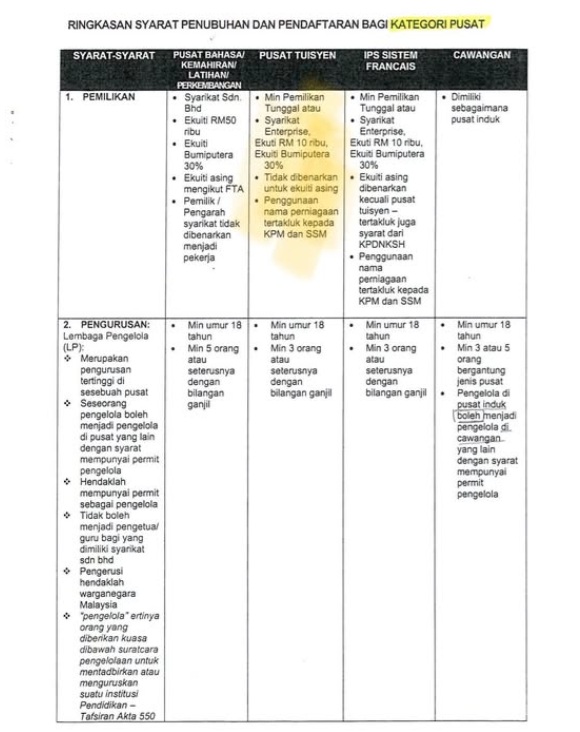
The Ministry of Education under Datuk Seri Hishamuddin Hussein, in 2006, embedded a 30% Bumiputera equity requirement into the registration rules for private education centres.
The current administration is trying to prevent the policy from proceeding.
The policy stated that by 2027, centres that fail to meet this threshold risk losing their licences.
This was a policy introduced in the Private Education Institutions Policy Book, published in 2006 by the administration at that time.
Foreign equity is barred entirely for tuition centres. Existing operators must either restructure ownership or close.
The ministry then offered little public explanation of the policy rationale or whether the rule applies retroactively to long-established centres.
Picture from Facebook
Forcing equity dilution on small family businesses does not create genuine entrepreneurship.
It creates rent-seeking opportunities. Finding a suitable 30% partner who contributes capital, skills, and genuine involvement is difficult in a sector built on personal reputation and teaching expertise.
Many owners will face pressure to hand over shares at depressed valuations simply to keep operating.
Others will go underground, conducting classes in living rooms without licences, precisely the informal sector the regulations claim to professionalise.
Quality control, student safety and accountability will suffer.
The timing is especially damaging. Malaysian students already lag peers in Vietnam and Thailand on international assessments.
The private tuition market has been one of the few responsive parts of the system, allowing parents to address weaknesses the public schools have not fixed.
Injecting racial equity conditions into ownership of these centres does nothing to raise teaching standards, improve teacher qualifications or expand access for poorer students.
It simply politicises a service that thrives on merit and parental choice.
Specialised centres teaching emerging skills, such as AI, advanced IT, and creative arts, will be particularly constrained. Start-ups in education technology and niche training require agility and founder control.
Mandatory equity restructuring raises barriers to entry, deters investment and signals that successful non-Bumiputera operators will eventually be required to dilute ownership.
This is the opposite of an innovation-friendly environment. Countries that have improved education outcomes have focused on curriculum, teacher quality and competition, not ownership ethnicity.
The original New Economic Policy (NEP) aimed to raise Bumiputera participation in the economy.
Half a century later, the instrument has become a blunt bureaucratic tool applied indiscriminately.
Requiring every individual firm in an industry to meet a fixed equity percentage ignores the diversity of business models and the reality that overall sector participation can be measured more flexibly through total equity, employment or number of firms, without dismantling existing enterprises.
Family businesses that have served communities for decades should not be forced into artificial partnerships as a condition of continued existence.
The policy also sits uneasily with claims of reform under the current administration. Education regulation ought to prioritise standards, safety and outcomes.
Linking licence renewal to the racial composition of shareholding introduces an extraneous criterion that will generate compliance costs, legal uncertainty and resentment without demonstrably improving learning.
Small operators who cannot or will not restructure will exit or operate informally. Students lose options.
The informal market expands. Trust in institutions erodes further.
Malaysia cannot afford to damage one of the few functioning parts of its education ecosystem while international rankings decline. – September 20, 2026