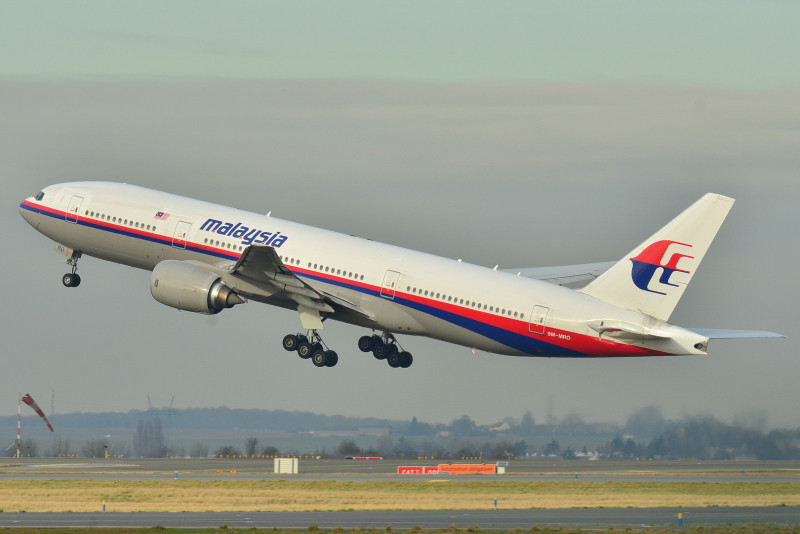
MALAYSIA Airlines did not initially know that MH370 had turned back after disappearing from civilian radar, with the crisis team instead searching along its planned route and considering hijacking after learning two passengers were travelling on stolen passports.
Former MH370 and MH17 crisis director Mohd Fuad Sharuji said the team’s uncertainty in the early hours of March 8, 2014, was compounded by its reliance on civilian radar, which did not reveal that the Boeing 777 had made a U-turn.
He said the possibility of hijacking was among the first explanations considered after INTERPOL informed MAS that two passengers had used stolen passports.
“From INTERPOL (International Criminal Police Organisation), we were informed that they were using fake passports. They entered Kuala Lumpur using their original passports but left using fake passports.
“So, at that time, we immediately thought that the aircraft might have been hijacked. Hijacking was the first thing that came to mind regarding MH370,” he said.
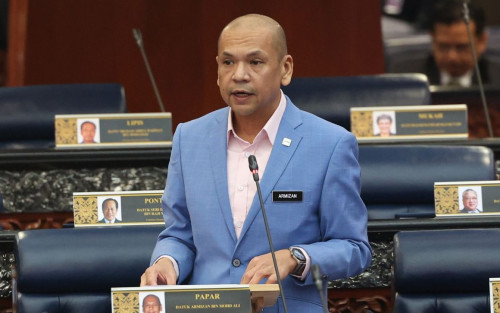
Mohd Fuad was speaking at a lecture titled “MH370: The Search, The Mystery & What Really Happened?” organised under the British Graduate Association of Malaysia (BGAM) Lecture Series in Petaling Jaya yesterday.
The lecture was moderated by Institution of Engineers Malaysia (IEM) Mechanical Engineering Technical Division chairman Dr Ricky Liew Chee Leong. Also present were BGAM president Datuk Kamarudin Md Ali, former Home Minister Tan Sri Syed Hamid Albar and BAC Education founder Raja Singham.
Investigations later confirmed that the two men were Iranian nationals who had boarded MH370 using stolen Austrian and Italian passports.
However, investigations found no evidence linking them to terrorism, while INTERPOL said the information pointed more towards migrant smuggling.
Mohd Fuad said he received a call from the Operations Control Centre (OCC) at about 2am informing him that MH370 had disappeared while flying from Kuala Lumpur to Beijing.
Four other MAS flights were also heading north-east at the time, bound for Tokyo, Osaka, Guangzhou and Incheon, South Korea.
“I asked the operations manager to contact the captains of the four flights concerned and ask them to try to contact MH370 using VHF radio, but there was no response.
“We also tried to contact the aircraft through satellite communications, but there was still no response, and at that point we knew something serious had happened to the aircraft,” he said.
Mohd Fuad said he then declared Code Red, prompting senior MAS management and relevant teams to assemble at the Emergency Operations Centre (EOC).
He said the crisis team initially had no indication that MH370 had turned back because its movements had been detected by primary military radar, while the team was relying on civilian radar data.
It was only the following day that they were informed the aircraft had made a U-turn.
“We contacted Hong Kong and Vietnam air traffic control, but neither confirmed that the aircraft had entered their airspace,” he said.
Mohd Fuad said the initial search therefore focused on the South China Sea for seven days, based on MH370’s planned route, before shifting to the Straits of Melaka and subsequently the southern Indian Ocean.
He said Inmarsat satellite data was later used to help determine the aircraft’s possible route after it disappeared.
He said Inmarsat was a communications satellite system rather than a means of directly tracking the aircraft, and that it was the first time the team had used the system.
More than a year after MH370 disappeared, a flaperon from the aircraft was found on Réunion Island in July 2015, after the search had shifted to the southern Indian Ocean based on the route believed to have been taken by the aircraft.
However, the main wreckage of the Boeing 777, which was carrying 239 passengers and crew, has yet to be found. - September 27, 2026