Malaysia

Sabah won’t back down on 40% revenue share under MA63: Masidi

Revenue split between federal, state govts under agreement non-negotiable, says minister

Updated 4 years ago · Published on

Sabah won’t back down on 40% revenue share under MA63: Masidi
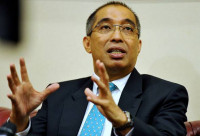
Datuk Seri Masidi Manjun, who leads the Sabah team in ongoing talks with Putrajaya on the revenue split, says the state government will not budge on this issue. – Bernama pic, March 21, 2022

by Jason Santos

KOTA KINABALU – Sabah has not given up its right to a 40% share of revenue generated by the state, as it is a fundamental term agreed to in the formation of Malaysia in 1963, state Assistant Finance Minister II Datuk Seri Masidi Manjun said today.

Last week, federal Finance Minister Datuk Seri Tengku Zafrul Tengku Abdul Aziz said the revenue share deal with Sabah was no longer applicable as it was deemed to be outside the federal government’s financial capacity.

Masidi, who leads the Sabah team in ongoing talks with Putrajaya on the revenue split, said the state government will not budge on this issue.

“The 40% is non-negotiable,” he said when interjecting on the debate of the governor’s speech by Ewon Benedick (Kadamaian-Upko).

Ewon had earlier asked about the status of negotiations between the state and federal governments on an ongoing review of the share of revenue Sabah earns from its resources.

“What is happening right now is that there are terms that we have agreed to and some still being negotiated,” Masidi said in response to Ewon’s question.

Tengku Zafrul had said last week that an upwards revision of the current revenue-sharing formula would be announced soon.

Sabah has been receiving a fixed annual payout of RM26.7 million from the federal government since 1973 as a share of revenue generated by the state, after both sides failed to come to a consensus on the percentage split during two reviews in 1969 and 1973.

Political leaders in Sabah have argued that the federal government had reneged on the 40% revenue share deal they said was agreed upon under the Malaysia Agreement, which brought Sabah, Sarawak, Singapore, and Malaya under one federation. – The Vibes, March 21, 2022
Related News

Malaysia / 3d

Pursue Sarawak’s rights, but do not compromise Federal interests - Fadillah

Opinion / 4d

When those entrusted to defend the country are accused of drug smuggling

Opinion / 1mth

The Malaysia Agreement 1963: Grievances and expectations in Sabah and Sarawak

Malaysia / 1mth

Budget 2027: Sabah, Sarawak to receive RM34.9b in federal allocations next year

Events / 1mth

Sarawak and Sabah play key roles in weathering climate change

Malaysia / 1mth

Address security concerns and let concert proceed – former Sabah CM

Spotlight

Malaysia

Anwar receives special recognition as 10,000 Muslims gather in Putrajaya

Malaysia

Video of elderly man being assaulted goes viral on social media

Malaysia

The wide reach of corruption and organised crime in the country

Malaysia

Malaysia pushes to give smaller economies stronger voice in Asia-Pacific trade – Anwar

Malaysia

No tsunami threat to Malaysia after 5.4-magnitude earthquake hits Banda Sea

Malaysia

Who is calling the shots in Negeri Sembilan as Ismail’s position comes under scrutiny?

Opinion

Ayob Khan: When the uniform comes off, the principles remain

Malaysia

MySiren to send emergency alerts to compatible phones nationwide from Nov 29 test

You may be interested

Malaysia

AKPS vows to help police uncover wider migrant-smuggling network after officer's arrest

Malaysia

The wide reach of corruption and organised crime in the country

Malaysia

Govt eyes up to 250,000 jobs from RM170bil carbon capture industry by 2050

Malaysia

Teacher remanded 7 days over alleged sexual assault of 17-year-old student in Terengganu

Malaysia

KLIA Customs intercepts methamphetamine shipments disguised as vape cartridges, Chinese tea

Malaysia

Ex-cop turns to police, AG over 2015 assault allegation against AKPS chief

Malaysia

Elderly man’s rampage leaves police officer injured in Sungai Besar

Malaysia

Fourteen diaries preserve 100-year-old woman's first-hand memories of Japanese occupation