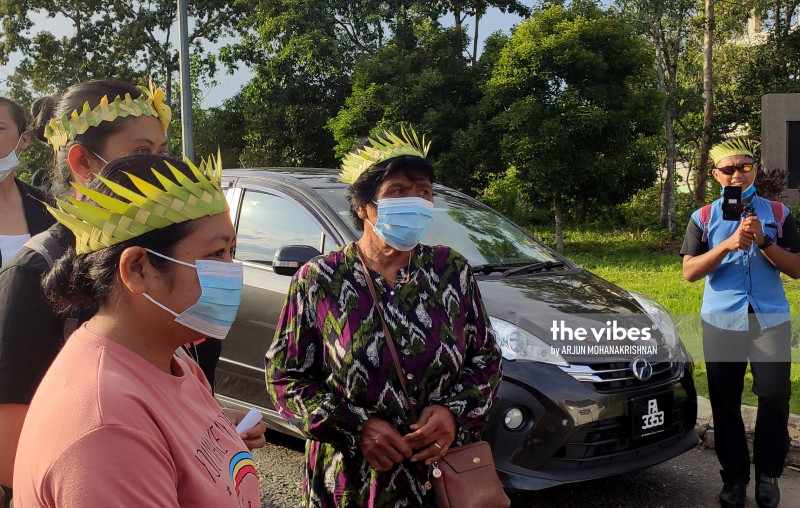

KUALA LUMPUR – When it comes to land rights, Malaysia’s aboriginal people – the Orang Asli – oftentimes have it rough.
In the peninsula, those residing in Perak, Negri Sembilan, and Pahang have the toughest time of all.
In its 2019 report, the Human Rights Commission of Malaysia (Suhakam) stated that the bulk of the complaints lodged with it by the Orang Asli communities from the three states concerned land encroachment.
The intrusion of the communities’ ancestral lands is a long-standing issue, borne out of their seemingly ignored customary land rights despite landmark court rulings recognising the legality of the Orang Asli’s ancestral lands.
In Malaysia, matters concerning the Orang Asli are under the purview of the sultans of the respective states, with some involvement from the federal government via the Orang Asli Development Department (Jakoa).
And while Suhakam had already submitted 18 recommendations to better handle Orang Asli’s land rights to the federal government in 2013 – following a national inquiry in 2010 – progress has however been slow.
“Suhakam believes that the government is too slow to implement the national inquiry’s recommendation submitted almost six years ago, and has not changed the status of the community as the most vulnerable and marginalised group.
“Suhakam urges relevant agencies under the Prime Minister’s Department to facilitate and expedite the process to recognise the native customary land rights of the Orang Asli,” read Suhakam’s report.
The blockades in Perak, the quarry in Negri Sembilan, and the limbo in Pahang
Back in 2019, some of the notable issues and controversies relating to Orang Asli land rights and lack of access to basic necessities in the three contentious states include Perak, where the then-menteri besar Datuk Seri Ahmad Faizal Azumu remarked that there were “no such thing as ancestral lands” vis-à-vis the blockades set-up by the Orang Asli in Kg Sungai Papan and Kg Cunex, Gerik.
The blockades were to prevent logging activities in the nearby forest which the Orang Asli claimed to be their ancestral land.
In Negri Sembilan, the Orang Asli in Kg Gebok, Nilai, were traumatised by quarrying operations near their settlement that had caused floods, air, and sound pollution. Their worries worsened when a private company applied to operate a quarry even closer to their settlement. But after Suhakam intervened, the state government rejected the company’s application.
In Pahang, 13 Orang Asli settlements in Pekan, Rompin, and Bera complained over the frequent encroachment into their native customary land, graveyards, and lack of basic infrastructure facilities such as clean water, electricity, education, healthcare, and paved roads. This was despite the settlements having already been recognised by the state government.
However, the settlements are yet to be gazetted pending mapping work by Jakoa, which will be carried out in phases based on available funding. Only gazetted settlements are eligible for the said facilities.
The free, prior, and informed consent principle
The remedy that Suhakam and rights activists believe can solve customary land disputes – especially concerning developments within Orang Asli lands – is the adoption of the free, prior, and informed consent (FPIC) principle.
Popularised by the United Nations (UN), FPIC is basically a guideline that allows indigenous peoples to give, withhold, and withdraw consent to a project that may affect them or their territories.
And while Malaysia is a signatory to the UN charter, which stipulates the need for FPIC to be practiced in its administration, the reality on the ground, however, is the opposite.
Despite the existence of the country’s Aboriginal Peoples Act 1954 – also known as Act 134, FPIC is not practised.
“This is not so,” said Orang Asli activist Tijah Yok Chopil of the Orang Asli Villages Network in Peninsular Malaysia group.
“When the (state) government wants to take over our lands, they simply inform our batin (village head) of the date and time and where we will be relocated. They deem this a ‘discussion’ but it is not,” said Tijah in a webinar on FPIC recently.
“In fact, the size of an Orang Asli village and what they can do with the land are not determined by the Orang Asli themselves. Not once have I ever seen the principle of FPIC being adhered to by the government,” she added.
Although politicians are often solely blamed for the predicament of Orang Asli – the poorest community in the country – Suhakam commissioner Jerald Joseph contended otherwise.
The business sectors, he said at the FPIC webinar, are equally responsible for exploiting loopholes in the system.
“Also, Malaysian society at large is equally oblivious on matters regarding Orang Asli land rights.
However, not all is doom and gloom.
In his presentation during the webinar, Jerald pointed out that Suhakam recently had a meeting with the federal government – on October 14 – on Orang Asli land rights matters and proposed six recommendations in the meeting.
Some of these recommendations include the need for Orang Asli lands to be gazetted in accordance to Act 134, proper and detailed studies on customary lands, increased participation of Orang Asli in development agendas, and the restructuring of Jakoa.
“The selling point that we should all strive for is that bettering the well-being of the Orang Asli is good for the nation,” said Jerald. – The Vibes, December 14, 2020