


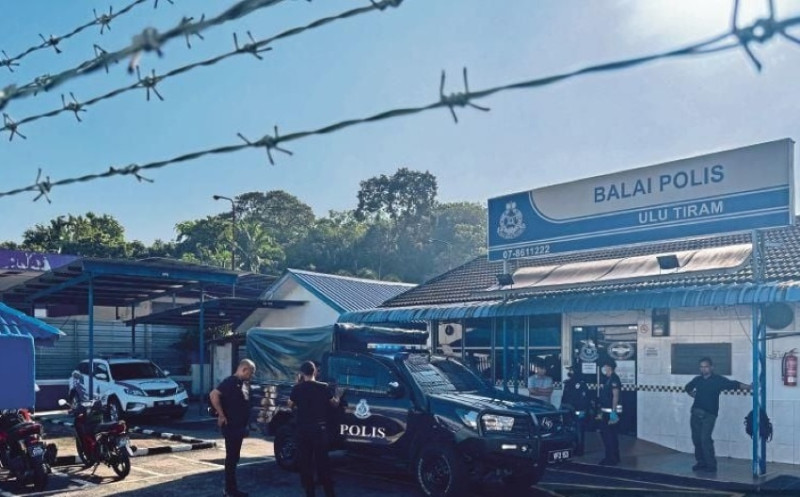
OVER a year ago the deadly attack at the Ulu Tiram Police Station in Johor - which claimed the lives of two young officers — led the government’s move to gazette all police premises as restricted zones and now is being widely regarded as a necessary step to enhance the safety and sanctity of law enforcement institutions.
On 17 May, 2024 a terror assault on the Ulu Tiram station was not an isolated case.
It joined a list of violent incidents that have targeted police stations over the decades. On 16 October 1980, a group affiliated with a deviant religious sect stormed Batu Pahat Police Station in Johor, injuring 23 people, including officers and civilians.
In February 2001, Guar Chempedak Police Station in Kedah was attacked by extremists reportedly attempting to seize firearms, leaving two officers injured. In 2017, a lance corporal was killed at Pinggiran Subang Police Station in Selangor after being shot and slashed at close range.
According to the Royal Malaysia Police (PDRM), the force operates 14 state police headquarters (IPK), 148 district headquarters (IPD), and 837 police stations across the country.
In light of such threats, the gazetting of all police premises and their immediate surroundings as restricted areas is a timely measure to bolster the nation’s internal security infrastructure.
The decision was reportedly made after a detailed risk assessment, factoring in the growing unpredictability and complexity of modern extremist threats.
This gazetting grants PDRM stronger legal authority to control access and conduct inspections on those seeking to enter the area,” a recent security commentary and news reports noted.
Put simply, anyone attempting to enter or photograph the area without approval may face legal consequences. The directive is also expected to deter would-be attackers from conducting reconnaissance or surveillance activities on police facilities.
Nevertheless, concerns have been raised over the need to strike a careful balance between heightened security and public accessibility. While stricter controls are necessary to limit unauthorised entry into strategic zones of police premises, it is equally important not to alienate the public.
Public-facing services such as reporting crimes, paying traffic summonses and lodging complaints must continue through front counters, digital apps and other public channels. Physical access may be restricted, but openness in service must remain.
The Ulu Tiram incident also highlights the need for PDRM to upgrade internal safety protocols, including automated security systems, biometric identification, dual-perimeter fencing, scheduled patrols, and 24-hour CCTV monitoring.
Additionally, the formal designation of restricted areas will enable the allocation of special funding to update infrastructure at stations previously exposed to potential threats.
Ultimately, the policy is a firm declaration that enforcement agencies like PDRM are committed to protecting their institutions from extremist violence and threats to national stability.
With the lessons from Ulu Tiram, internal security can no longer be taken lightly. The gazetting of all police stations, IPDs and IPKs is critical to safeguarding the lives of our security personnel.
A deadly pre-dawn attack at the Ulu Tiram police station in Johor on 17 May 2024 left two police officers dead, another injured, and a suspected assailant shot dead in what authorities believe may be linked to the regional militant group Jemaah Islamiyah (JI).
The incident began at approximately 2:30am when two college students entered the station to lodge a report regarding an alleged molestation incident that had occurred two years earlier. Just five minutes later, a man arrived on a motorcycle and proceeded to the rear of the police station.
Constable Ahmad Azza Fahmi, who responded to the unidentified individual's presence, was fatally stabbed by the suspect, who also seized the officer’s firearm. Two other policemen rushed to the scene, prompting a shootout in which Constable Muhamad Syafiq Ahmad was fatally shot, and another officer sustained injuries.
The suspect was subsequently gunned down by a third officer who responded to the attack.
In the aftermath, the two college students were detained for questioning regarding their possible connection to the assailant and the circumstances surrounding the attack.
At around 6am the same morning, police raided the suspect’s family home in Ulu Tiram, arresting five individuals believed to be affiliated with the outlawed terror network Jemaah Islamiyah. - May 22, 2025








